

The Panic of Losing ChatGPT
I love AI. ChatGPT is definitely worth the 90 odd ringgit I spend every month. I had a panic the other day. My credit card had expired prior to the monthly payment and all the features I’d come to love and rely (depend?) on weren’t available and I was told its memory was full. It felt similar to being hacked watching all my crypto being sent from my wallet to the thief’s…helpless, and a bit sad!
I put my new card details in and my productivity and happiness were restored. I felt like I imagine Eddie did when he found a load more pills in the oven in Limitless.
Did it come too late?
ChatGPT came out in the November of 2022, 2 months after I had submitted the dissertation for my MBA (I pressed submit a matter of minutes and seconds before the deadline). I was probably amongst the last cohort forced to submit a fully authentic piece of work! And to be fair, my MBA might’ve been the last truly original thing I wrote without any ‘help’. Knowing what AI can do, a massive part of me wishes I’d had it during those long nights and weekends of writing…just for support 😬.
Better late than never
Since forming a (very strong) relationship with AI (I genuinely feel it has become part of my life), I have loved what it offers me, but I have also had mixed feelings about it helping me to write. Like many people, it contributes significantly to my operational emails, general work productivity and output, it replies to parent emails for me, I use it to quickly analyse data and I have some cracking prompts set up that help me to operate more efficiently and at higher level, faster than I ever could before. I definitely shift way more work with it. I have pretty much tried to use it in every way I know, and I will continue to try new things all the time.
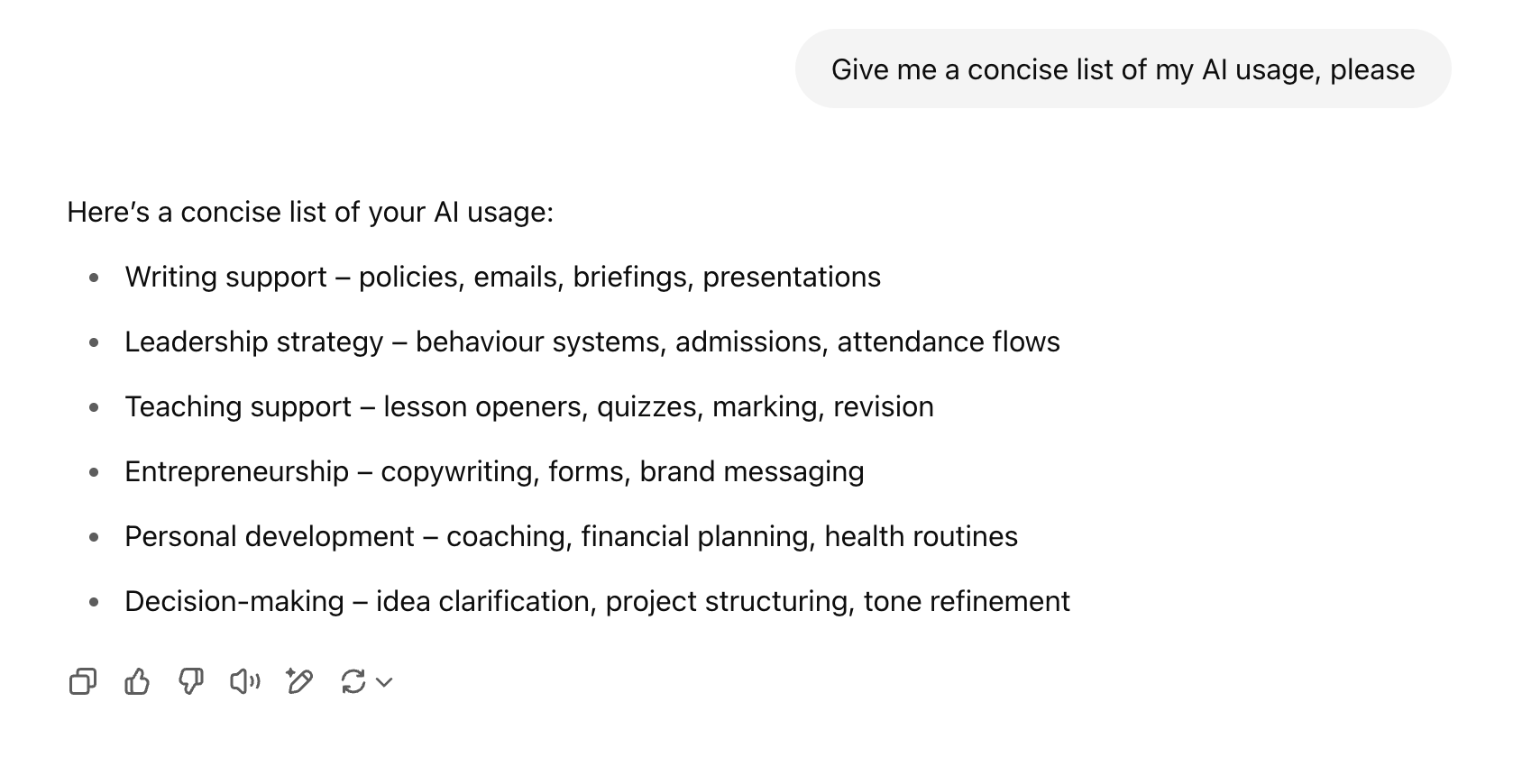
The panic highlighted that I my have acquired an AI dependency: for both the trivial and even for some of the essential things in my life…my “Phys” project prompt is way better than Dr. Google.
High Agency
I know some people are a bit uneasy about all the AI use. I was using it pretty much as soon as it was available, experimenting with ways to save time, be more creative and get more done. So were a few colleagues and pals and we’d constantly be sharing prompts and tips. I loved how much easier it made work. You do wonder how much of you is in the work. Having spent the previous two years working hard to research and write my MBA, it did feel like I was cheating all of a sudden. I could produce more and better output within a fraction of the time and effort, which gets you thinking about how long could this game (or our jobs) last? Especially as more and more people were beginning to use it. Sam Harris has long spoken about the dystopian (probably not so distant) future, where AI brings about massive labour displacement and existential risk. Here he is discussing it in 2017. I very soon began to hide my AI use, a bit like a school kid pretending to be smarter than he is and not get caught. Not that getting caught really would have meant anything then, other than seeming to be a hypocrite: Our school, like most I imagine, was initially concerned about plagiarism and authenticity, and we considered how we might catch kids cheating with AI. Much of the education profession seemed to see AI as a tool for cheating and as something to skip the hard yards in the learning process. I do think things have since caught up, especially at our place where the conversation has become more progressive and nuanced.
Hiding the Help
I quickly reconciled any feelings of guilt for using AI at work given the hockey stick-shaped increase in my work efficiency and productivity. I also enjoyed the process of covering it up, a bit like the smart kid that pretends they didn’t spend hours revising to get a good score, I was actually putting in quite a bit of effort to edit the output, and to refine and perfect my prompts to ensure everything produced was still ‘me’. During this cover up phase, I would remove all evidence (I knew of) in my emails and work docs that I might show I had used AI to produce it, and through doing so, I began to develop quite a heightened sense of awareness for the tells of any AI presence in any written work.
Most people can probably tell if AI has contributed to something written. Aside from the obvious: it was written in 2025 (too cynical?) or how slick someone’s writing became overnight, there are a few very obvious tells that once you start recognising them, they can’t be unseen. In an attempt for my AI use to go unnoticed I became adept at removing the many more obvious tells in my work, like all the em dashes (“—”). I would enjoy doing a quick “CMD+F and replace-all” to switch them all out, leaving behind loads of satisfyingly normal hyphens.
Before refining my prompting, I would filter obsessively. A side-effect of that was I became heightened at seeing traces of AI wherever I looked. A quick scan of an email and I know if AI contributed. You can’t help seeing it…classic Baader-Meinhof effect (Red Car Syndrome). It’s great that everyone writes better all of a sudden, I suppose it is similar to what the word processor did for those of us with bad handwriting, just on a whole new level. These are some of the most common things that cannot be unseen when AI is present:
Dripping in em dashes “—” (and en dashes “–”) - I like to use hyphens in my writing…and an occasional ellipsis (quite a lot, I am told)…but AI seems to prefer to flood writing with those (probably correct) longer dashes. Before AI, I never noticed them. I think it was only ever proper authors and those who understood grammar that used them. In Substack, a double tap of the hyphen key gives you one…but people rarely used them in emails — until now.
Unnaturally consistent tone and a lack of trust in the reader - people tend to wander, get distracted and double back in their writing. AI writing is way too consistent, unless edited or a skilful prompt is used. AI doesn’t digress and sticks to the point throughout and will add clarity at the end of sentences to make them feel more complete. People don’t bother. People tend to trust their readers (or don’t even think about it) whereas AI adds these dangling explanations that aren’t needed.
Perfection - Similar to the point above, people make errors. AI rarely does (apart from those dangerous hallucinations). People who might never have used punctuation properly now suddenly use it like they’ve read The Elements of Eloquence, and have mastered the semicolon; their sentences actually make sense. (I checked that, and am still not sure if I have used correctly). AI also seems to add fake sophistication using big words for effect that probably work, but are just not how the person writing might normally write.
Dodgy bullet points and weird formatting - These always annoy me and are spotted a mile off. Things like bullet points in emails or posts when the writer has never used them before, which are obviously pasted in directly from their clipboard. They often come with a tab before and after and aren’t actually in the format of the software used. There might be bold words for emphasis, often at the start or key terms, people might have used them before, but AI overuses them.
Emojis - 🤬
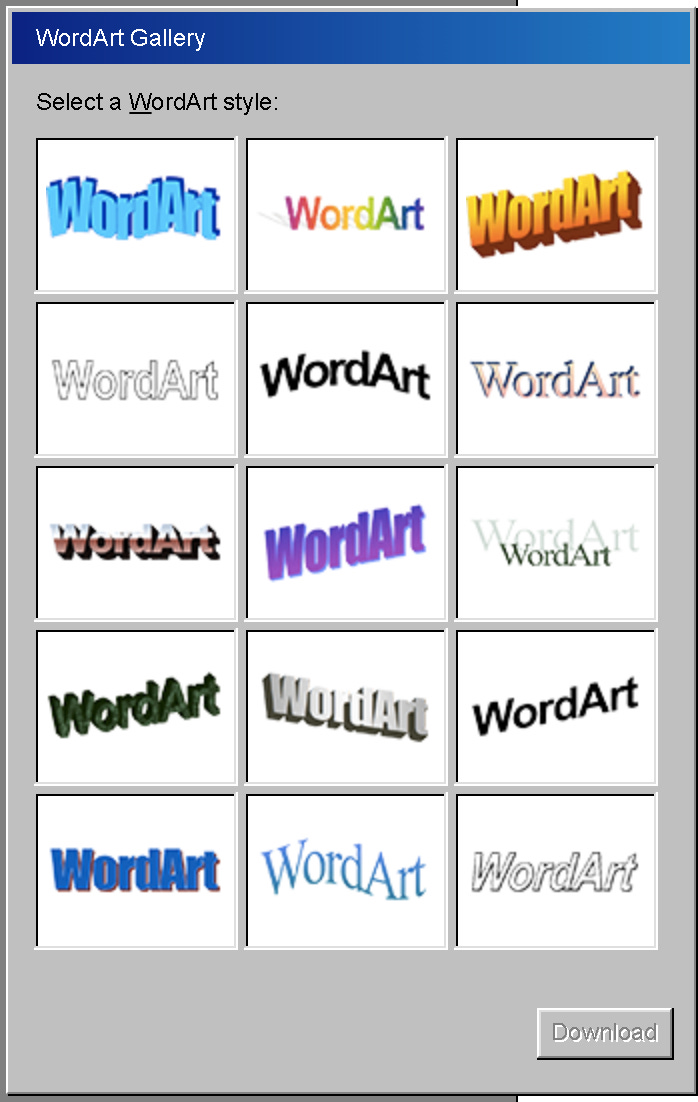
6️⃣ Numbered lists, ✅ green ticks and ❌ red crosses - No one would ever choose them on their own, they remind me of Word Art. Plus those big horizontal lines are another telltale sign.
US spelling - I remember one of my earliest prompts was to permanently set ChatGPT to British English after getting fed up of all the ‘z’s. I’d have to carefully check that my Find-Replace hadn’t messed up any words that were supposed to have a ‘z’. It’s all good fixing ‘organize’, ‘memorize’ and ‘emphasize’, but it will mess up your pizza.
I know everyone is using AI now but these can’t be unseen. I think that the speed and scope of adoption has led to its use becoming being normalised, accepted and in many cases, expected. Either people don’t know how to hide it, or probably don’t care to.
Writing Through It
I’ve been the most cautious around AI where my own personal writing and reflections are concerned. Of course, I’d be lying to say I hadn’t thrown full posts or paragraphs into ChatGPT for feedback - it can be very kind (too kind?). I used it to check grammar or get the odd suggestion for how to tighten up paragraphs. That said, whilst I have been journalling for some time, I started writing this Reflections blog long after I started using AI at work, and I have always wanted to retain my own voice and tone and felt funny about using it for any non-work writing. Is having AI write the message for my mum’s Moonpig birthday card alright? She’d never know, but I would. What if you listed all the things you wanted to say and AI made them all make sense in a beautifully constructed way? Is it still you? I don’t know..So, for me, my biggest use of AI has always been about time-saving, efficiency and productivity at work, as well as creativity and idea generation when working on projects. A great prompt I got from Tyler Cowen, that I add into some of my projects is “destroy this work for me…” (the prompt is way longer and more sophisticated), and you find holes, issues and solutions you never knew you’d need.
The Agency Question
Schools have long been interested in the concept of agency. More so lately, maybe, or certainly more so at our place, and I don’t think we are particular good at developing it, yet. We know what it is but can’t seem to find the time or approaches to build it. Agency is described by Wikipedia as “the capacity of individuals to have the power and resources to fulfill their potential”. In psychology, it is considered the feeling and ability someone has to control their actions. George Mack and Chris Williamson discussed agency on the Modern Wisdom podcast; more specifically High Agency. Mack sees it as one of the most important ideas of the 21st century, and having high agency is considered a key indicator of being successful. Mack explains high agency through a thought experiment asking who would be your one phone call if you found yourself in a 3rd world jail cell? He asks, “what is it about the person who you called to get you out?” Whatever that is, it is likely that they are a high agency individual. Mack says life happens to Low Agency people. Whereas, High Agency people happen to life!
Agency is important, we want it and we want it in our children. But if we are using AI all the time, and for everything, could it deplete our agency? This cracking Gurwinder Bogle piece is an 8-letter correspondence between him and Freya India, that goes pretty deep. They discuss agency and how AI might be stripping back the agency we have as individuals, and how automation and AI further exacerbate the a natural laziness in humans. But Gurwinder explains how low-agency people might use AI very differently to a high-agency person:
“The low-agency person would grow more dependent on the AI to think for them, while the high-agency person would use AI to help them think for themselves.”
I love his idea that AI is a personality and agency amplifier, taking from low-agency people and giving to those who already have it. As I read the exchange, my confirmation bias made me feel much better about my AI use. It made me wonder if I was a high-agency person. I thought about asking ChatGPT to make me a ‘high-agency test’ and build me a 30-day high-agency training programme, just to be sure. But then I thought that might be exactly what a low-agency person might do. Thankfully, the test and course aren’t needed as Gurwinder went on to explain how doing more thinking, specifically through writing and journalling, are excellent ways to develop the brain’s muscles and build agency. Having read the post in the middle of writing this, I felt I might be on the right track to building more agency! Gurwinder shares some brilliant prompts (not for AI but for journalling and reflecting) that really make you think and he explains how writing can really help you understand yourself better, gaining clarity over what you want and don’t want.
I have to agree. We know writing by hand is way better than typing, which is why I rarely allow my students to use their laptops in class. All notes, revision, assessments, and of course, their final exams, are handwritten. We try to ensure our students do their thinking and creating in front of us, and any essays they submit for feedback are to be handwritten - there is a chance they can still cheat with AI to build them but I hope we have sufficiently conveyed the importance that what we give feedback on needs to be their thinking and their best work in order to move them forward. We have taught some specific ways to use AI effectively, but this is an ever-evolving area that we are still playing with.
Writing with AI
I found this conversation with Tyler Cowen on the How I Write podcast to be probably the best on the subject (video below, I really recommend watching it). It was comforting in terms of my AI use and gave me lots of great ideas for how to use it even better. Tyler spoke about mostly using AI to help him think better, seeing it as secondary literature when reading and researching to better understand the topic. He uses it as a thinking companion, like a high-end research assistant. He asks AI questions and interrogates it about the guests he’ll be interviewing for his podcast, asking questions about chapters in their books. This saves him hours and from having to buy and read lots more books in order to prepare. it also helps him better understand his pleasure reading in a similar way.
Tyler explains how certain types of writing will change and become redundant - AI has essentially removed the ability to write predictively and anything that makes predictions won’t be worth reading due to the speed of change, which is a scary thought. It will be pretty bad at writing biographies, as it will only use information that is available online. You need to speak to people, know what is in their heads to be able to write anything decent. I love how Tyler uses AI to test where he is being obnoxious or might annoy people in his writing. This then allows him to edit his work to be less controversial, if that is how he wants it to be received.
Tyler thinks generic content is killing a lot of what is written, and that the idiosyncrasies and weirdness of a writer need to be retained for it to be interesting and worth reading. AI might clean them up and he is dead against that happening in his work. Being personal, distinct and weird is critical to being future-proof for writers. He will never let AI write for him and wants to retain his writing as something personal to him. He uses it a lot to think better, learn and be creative but the words he writes are all his, with a bit of checking for tone, that he might then edit himself. I would definitely recommend watching.
Thinking With It
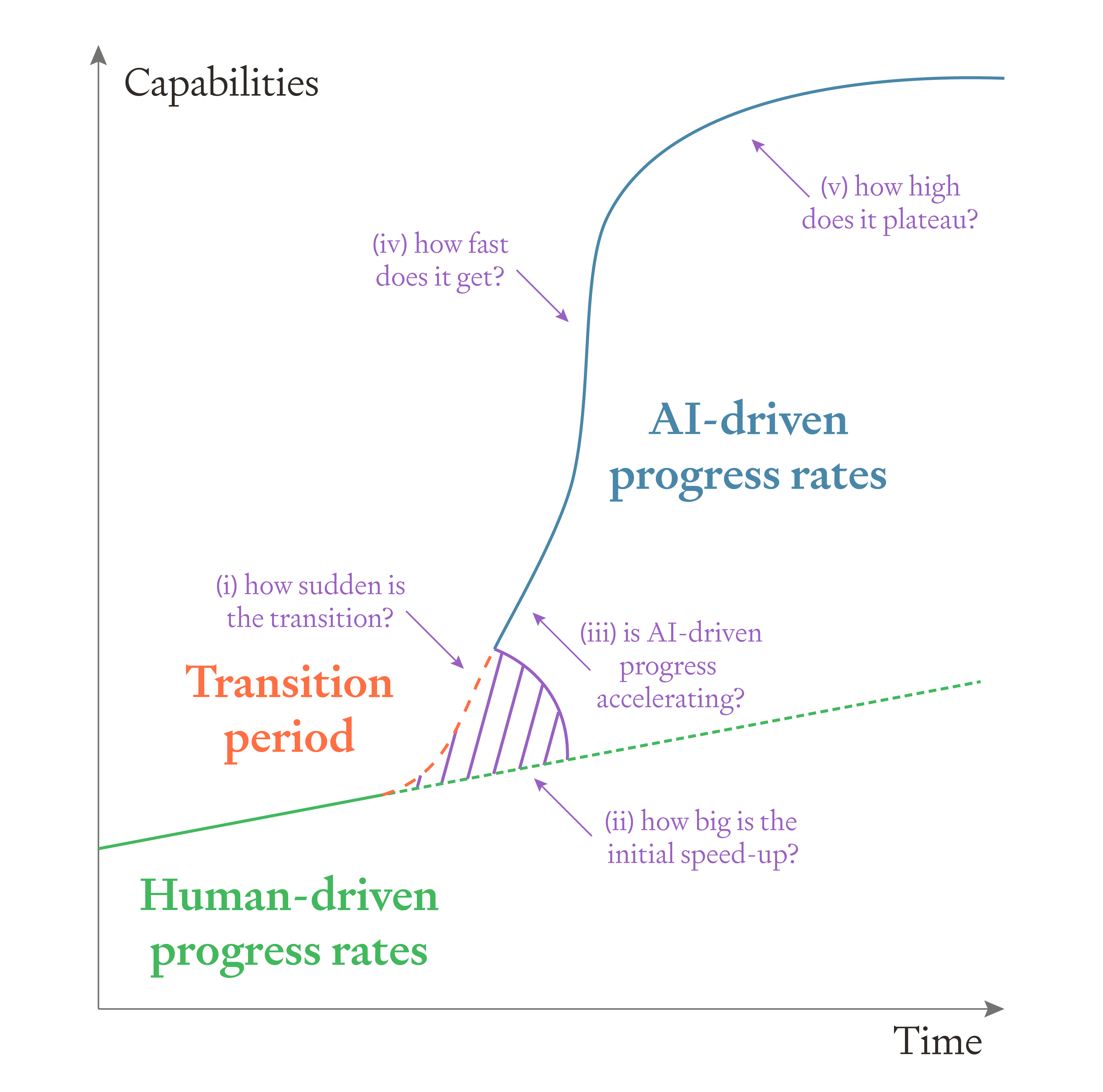
So for me, AI has been a wonderful tool that I have incorporated heavily into my work-life. I remember hearing the AI will replace us. And then that it won’t be AI replacing us, just someone who uses AI better than us that will. For now, who knows? Like Tyler says, writing anything predictive is so hard, and we’ve never seen progress at this rate. Until recently, it was human-driven AI progress but now we will be seeing AI-driven AI progress.
So now what?
Obviously, I will keep using ChatGPT. Loads. It helps me move faster, think better and push more work out, freeing up my time for more of what I want to do. But I will also keep doing my own writing and journalling. I think it is essential to write to retain agency and to continue growing it. I think this now more important than ever. For me, my own kids and the students I work with.
So I’ll keep thinking with it - but not through it. AI is a tool, but not an author. So, it was me that wrote this, at least I think it was.
Good read mate - thanks for writing (or did you?!). It depends what we are writing for. I was having a conversation about report writing in the office, some awesome teachers were telling me that they all sound the same (now - like they haven't been copied and pasted for years!) and the over-use of language takes away the personal tounch. My view is that parents want a detailed account of their kids learning and what they can do to improve. That is what a report is for, the parents. The parents do not see all the other reports and therefore if their report is detailed, consistent with what is happening in the classroom and helps them understand the progress, job done. AI is a great tool for it.
I think the content above would have been naff if you had used AI though I am sure you did to research. I did write my dissertation in the days of AI - it was a wonderful research assistant and allowed me to cover a far greater scope of ideas. However, construction of my dissertation was still completely my idea, as was the writing. I think we might be at the stage where that is the most important thing - to not forget we have our own brains just because AI can throw something quickly together - mind you, as in reports, sometimes that does the job!