

Attendance comes up repeatedly across schools. In every international school I’ve worked in, the pattern holds. Different student bodies, different countries, same issue. Most leaders will say it’s a priority. Far fewer can point to the specific drivers of absence in their context, or hold the line when pressure to make exceptions builds.
The contrast with England is useful. There, attendance carries legal weight - fines, court orders and statutory follow-up exist. Problems remain, but the expectation is clear and enforced externally. International schools operate without any of that. No fines, no courts, no external enforcement. Attendance becomes a test of what a school is prepared to insist upon, and who is willing to back that when it is tested.
At our school, the causes are familiar. Term-time holidays taken with minimal friction. Families flying mid-term for graduations or relocations, turning what could have been a short absence into two weeks out. Younger siblings watching older ones disengage and drawing their own conclusions. Affluence reinforcing the belief that outcomes are insulated from habits - a belief that does not hold, but often appears to, especially when the eldest got into a decent university despite a patchy Year 11 record. Many parents see school as a service they pay for that they can opt in and out of as suits.
Sport adds its own complexity. Swimmers missing extended periods for meets, golfers chasing ranking points, tennis players labelled elite long before results justify it. Sport has genuine value and schools should support it seriously. The issue arises when school becomes the flexible element rather than the fixed one, and when aspiration quietly hardens into assumption. For a small number of genuinely committed student athletes, we have devised an elite sports programme that operates as a formal contract - monitoring missed school, building in time for catch-up work, and keeping lines of communication open. It reflects an attempt to work with students and families rather than against them, while making clear that the academic commitment is not optional.
These patterns point to an important question. Are families clients purchasing flexibility, or partners in a shared educational contract? Where that is not defined, expectations easily drift and decisions lose consistency. Once absence becomes negotiable for some, it spreads. It is usually led by the families most confident the rules will bend for them, and once that line is crossed, it is hard to re-establish.
Most schools also carry a group of students whose absence is already entrenched. Early intervention still has value, but the window is narrower. Once patterns settle they are harder to shift, and the gap between the student and the curriculum widens in ways that are difficult to close.
Timing compounds this. Missing school early in the year disrupts access to core knowledge, routines and expectations as they are being established. Later recovery rarely closes that gap fully. Learning accumulates. Time lost early carries a cost that follows students further than they or their families tend to anticipate.
This becomes clear at secondary. Entry remains relatively inclusive up to Year 11, but our Sixth Form is not. Places are limited, standards are high and outcomes are exceptional, so competition is tight. Low attendance rarely sits alongside the IGCSE grades needed to keep options open and enable progression. Absence narrows pathways, and once decisions are made, reversal is rare.
Students who are academically able are no longer guaranteed a place where attendance falls below a set threshold. In marginal cases, offers become conditional.
Some students struggle to attend because of genuine wellbeing concerns - anxiety, mental health pressures and family strain are real and require proper support. But support that consistently removes the expectation to attend teaches avoidance, and students who learn to opt out when things feel hard are not developing the tolerance for difficulty that school is partly there to build. Schools have a role in that, not by dismissing need, but by refusing to treat absence as a reasonable response to it.
For years, our policy set 93% attendance as acceptable - roughly 13 days missed across a year. Writing that number into a policy document legitimised absence and signalled to families that missing nearly a tenth of school was within the rules. The data reflected it faithfully.
We have far from solved attendance; I am not sure it can be fully solved. What we have done is stop treating it as a problem that minor adjustments might fix. Expectations were rewritten, thresholds tightened, language clarified, and tutor practice and parent communication rebuilt rather than patched. One shift changed conversations before it changed behaviour: 100% attendance on reports was moved from “Excellent” to the baseline “Meeting expectation”. Anything below it required explanation, and that reset what needed to be justified - placing the burden back with families rather than with the school.
We also removed “authorised absence” from our language. The position is now straightforward: absence is absence. A school can understand a reason without endorsing it, and the language used to describe behaviour shapes what families consider normal. We also rewrote registration codes to distinguish between learning missed and learning relocated through school-led activity, because that distinction is key for accuracy.
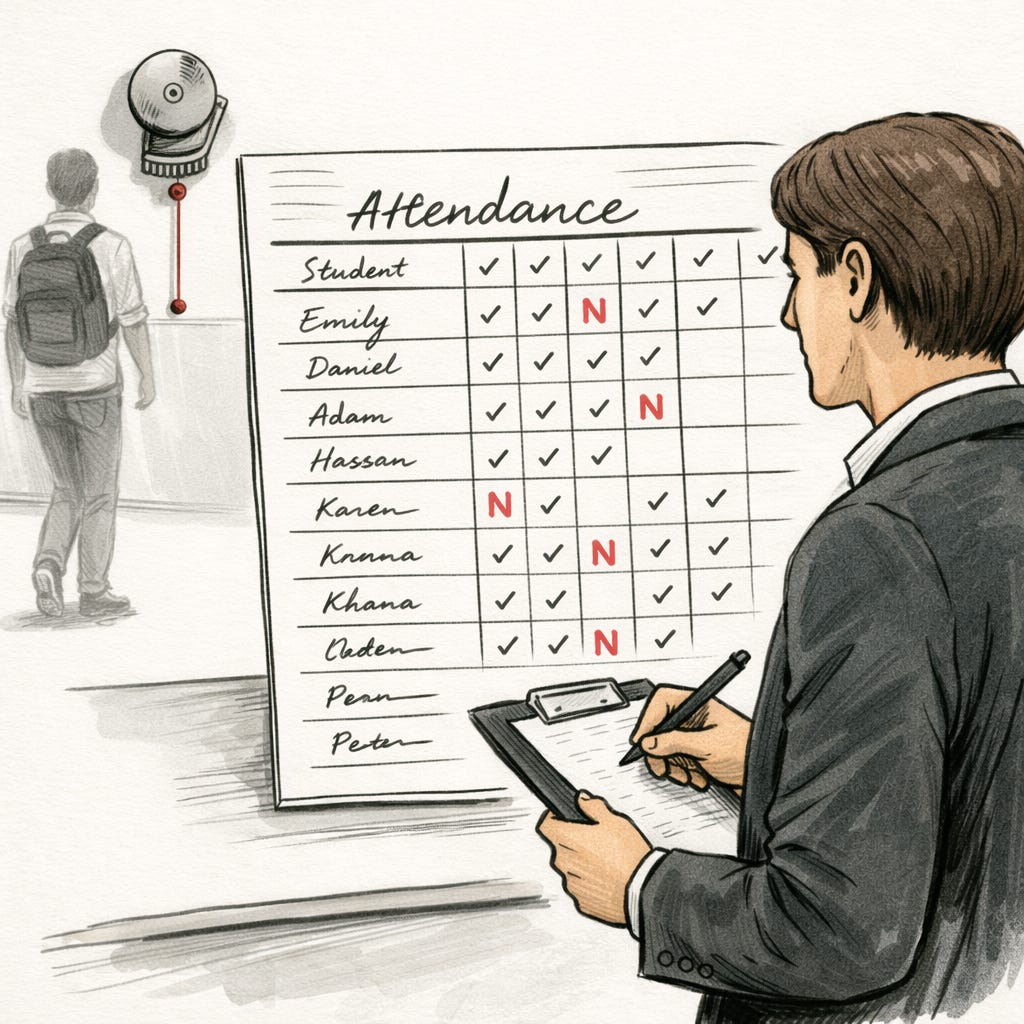
Attendance is now tracked more precisely, reviewed more frequently, and tutors are expected to act earlier. Our receptionist now calls home for all absent students where no reason has been provided, prioritising any CP students and sending updates to the relevant Head of Year and Assistant Head. Calls from tutors and Heads of Year also happen sooner, and we try to get meetings with parents set-up before patterns have time to embed.
For more complex cases, we have begun to explore and use Emotionally Based School Avoidance planning, because social anxiety requires a fundamentally different response from family-led absence. The work is slow and rarely linear, but the outcomes for the individuals involved have been encouraging.
We have always moved quickly with emails and calls home. What has changed is the next step. We now contact students directly where we can, rather than relying only on parents. In one recent case, I called twice in the same morning. On the second call I set a clear deadline and said I would come and collect them if they were not in school by that time. They arrived before it, but I was ready to make the short walk if needed.
I have not had to follow through on a home visit, but the credible prospect of one has been enough to shift behaviour. We have used home visits in recent years. This more direct approach, with clear expectations and a defined consequence, carries more leverage and makes it clear that we want them in, and that we are prepared to act on that.
This aligns with the Education Endowment Foundation’s rapid evidence review of attendance interventions. The evidence base is limited, but targeted approaches that address individual barriers directly show small positive effects. One study that included home visits saw attendance rise from 82% to over 91% across three months, with no change in the control group.
The review also found that personalised contact with parents is more effective than standard letters, and that reporting days missed rather than percentages produces sharper responses. A parent can accept 92% attendance without much resistance. Fifteen missed days, set alongside grades and post-16 options, is harder to ignore. Framed that way, the implications are clearer.
The data over time is consistent. Students above 95% attendance outperform those below 90% at IGCSE, AS and A Level. Exceptions exist, usually among high attainers, but they tend to encounter the consequences of their habits later rather than escaping them altogether. Attendance now sits alongside attainment and destination data in the same conversation, because separating them has never made much sense. You see some parents shuffling in their seats at Options evenings when the correlation is up there on the screen for all to see.
The research points to mentoring as having weak to moderate positive effects for persistently absent students, particularly where relationships are sustained long enough to carry weight. That is likely the next stage for us, alongside clearer formal agreements around sport and competition, and tighter alignment between wellbeing support and attendance expectations.
We have trialled older students working with younger students to support behaviour, attendance and punctuality. The numbers are small, but the impact for those involved was clear.
There is a limit, though. If students are not in school, the scope for any intervention is reduced.
None of this works, however, without clear and visible leadership from the top. Heads of year, form tutors and the staff members who genuinely care - the hero teachers who will make the extra call, stay late for the difficult conversation and chase the same family for the third time in a month - can shift individual cases. But they tire when they are working without consistent backing from above, and they should not have to sustain that effort alone. Without senior leadership reinforcing the same message in meetings with parents, in how exceptions are handled and in what is communicated at whole-school level, individual effort becomes isolated and eventually unsustainable. Staff read those signals accurately. So do families.
Strong attendance culture has to be owned at the top and felt throughout the school. Where that is absent, policy documents and data dashboards make little practical difference. The expectation has to be credible, and credibility comes from who is seen to be driving it and what happens when it is tested.
The EEF is candid that no single approach works across all contexts and that the overall evidence base is not strong. Schools should not over-claim. What that means in practice is less about finding the right programme and more about tracking your own data carefully, acting early and maintaining position when the pressure to yield builds - which it always does. Attendance holds only when the same expectation is applied repeatedly and visibly, by everyone, with every family. When alignment weakens, the numbers follow, and gains do not sustain themselves without continued attention.
That is where most schools find the work hardest. Writing the policy is the easy part, but holding position week after week without ceding ground through fatigue or the accumulated weight of cases that each seem, in isolation, to deserve an exception. Someone has to keep returning to the same standard. In an international school without external enforcement, that someone is always internal - and it has to start at the top.
In practice, that means:
define the contract early - attendance is expected, not optional
remove ambiguity - absence is absence, language is precise
track patterns, not events - act on early signals
act on day one - same-day contact, no delay
speak to the student - not only home
set clear deadlines - and follow through when needed
use proximity - home visits where possible / appropriate
link attendance to outcomes - progression decisions reflect it
align support with expectation - support does not replace attendance
hold consistency at senior level - no drift, no exceptions
The point about attendance being a test of what a school is willing to insist on—especially in international contexts without external enforcement—really resonates. In my current setting, this is compounded by context: many of our families work for the oil company, so school holidays don’t always align with when parents can take leave, leading to term-time travel. Add to that a highly diverse community with a wide range of religious observances, and absence becomes even more complex to navigate.
What stands out most is the shift from percentages to something more tangible—days missed, patterns formed, and long-term impact. That reframing feels powerful because it makes the consequences harder to ignore. I also think your emphasis on leadership alignment is key. In my experience, attendance doesn’t drift because of poor policy, but because consistency weakens under pressure. What you’ve outlined feels less like a programme and more like a cultural reset: clarity, consistency, and early action, held firmly even when the context makes that difficult.