

Every year we have the same conversation:
Where are our Heads of Year going to be next year?
Who follows their cohort?
Who is rotating back down, and how far?
It’s worth saying this up front, the Head of Year is one of the best, and often the hardest, jobs in a school. It is right at the intersection of behaviour, attendance, safeguarding, parent communication and student wellbeing, while also leading large numbers of adults who signed up to teach maths, chemistry or economics, not PSHE. It is emotionally demanding, operationally messy and, when it is done well, the graft is largely invisible. When systems wobble, Heads of Year are the ones holding things together, and they are often the first person teachers look to for help. Which is why how we design the role, and where we position it within the school’s structure, matters so much.
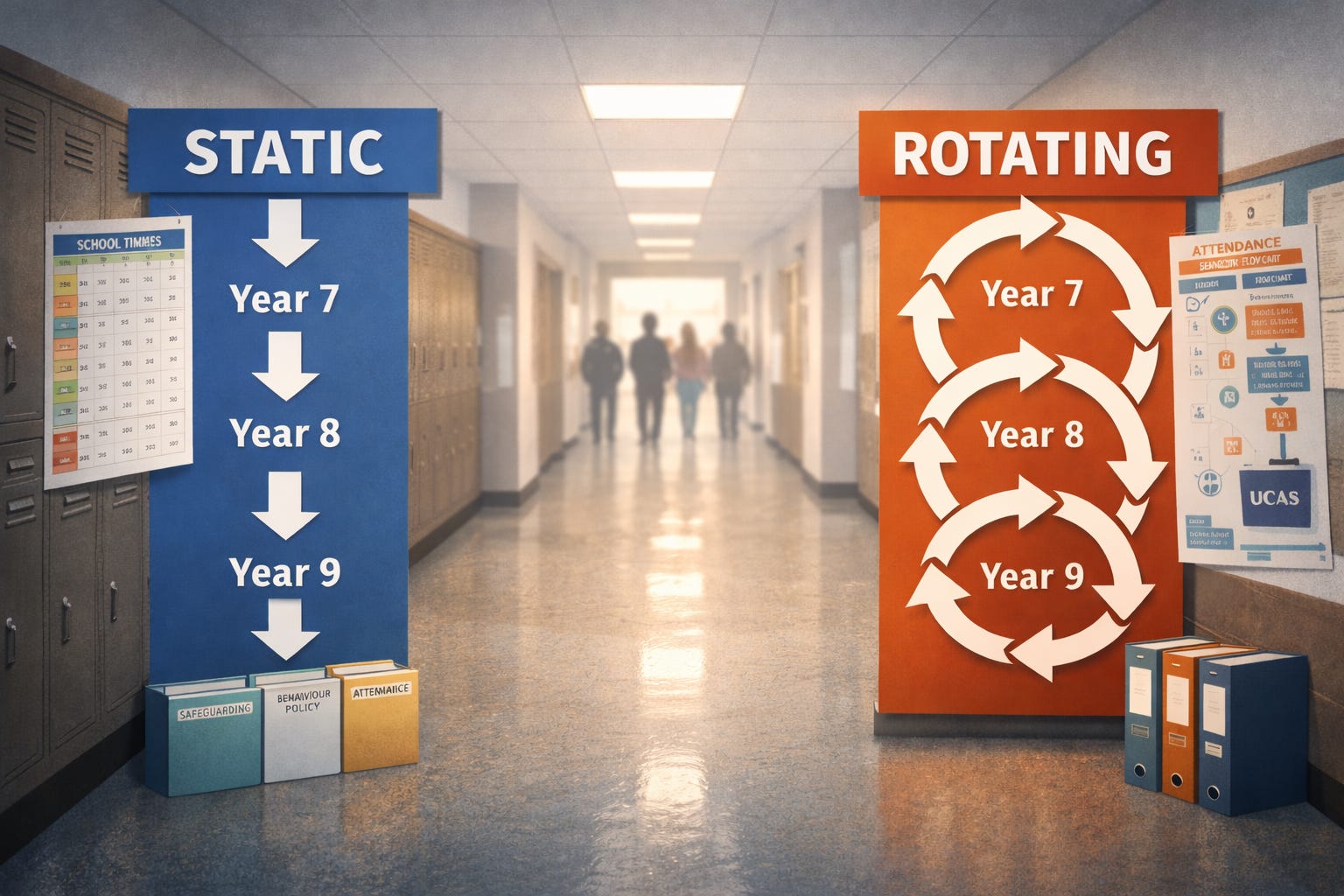
Our annual debate usually starts as logistics and quickly becomes something else. Preferences. Relationships. What people enjoy. What they feel confident doing. Expertise. What they would rather not give up.
What rarely features properly is a clear sense of what we are trying to optimise for.
This debate isn’t new. In 1987, Lesley Bulman was asking the same question in “Heads of Year - Rotating or Static?” Even then, the tension was clear: relational continuity versus phase expertise. Nearly forty years later, we are still circling the same trade-off.
What has changed is our understanding of how schools improve.
There is no modern empirical study comparing static and rotating Heads of Year (that I can find). But when you step back and look at the broader evidence on school effectiveness and implementation, the themes are consistent, even if they don’t give us a neat structural answer.
What is shown to drive impact
There is no substantial body of peer-reviewed research that directly compares static and rotating Heads of Year and measures their impact on attainment, attendance or wellbeing. The structure itself is rarely the independent variable in formal studies.
What does exist is adjacent research in three areas.
1, school connectedness. Studies consistently show that students who feel known, supported and understood by adults in school are more likely to engage and achieve. That work speaks to the value of continuity and relational trust. Whilst it does not prescribe a specific pastoral structure, it does suggest that stable adult relationships, particularly for vulnerable students, are protective.
This could support arguments for continuity in key transition years, although it does not determine how that continuity should be structured.
2, Leadership and system quality. Research on school leadership repeatedly finds that impact is mediated through staff consistency, clarity of expectations and the quality of teaching. Leadership influences outcomes indirectly, by shaping adult behaviour and strengthening systems rather than through structural configuration alone.
If rotating Heads of Year disrupts consistency, resets expertise and weakens system coherence, then it is likely to dilute leadership impact.
If static or phase-based models strengthen consistency, embed expertise and stabilise expectations, then they are more aligned with what leadership research says drives improvement.
3, Implementation and organisational coherence. Guidance from the Education Endowment Foundation, James Mannion and wider implementation research emphasises that sustained improvement depends on clarity, consistency and embedding practice in systems rather than relying on individual champions.
What it does not show is that one structural configuration of Heads of Year reliably outperforms another.
The debate, then, is not empirically settled. It is contextual and strategic. In the absence of clear comparative evidence, schools are forced to make deliberate decisions about what they are trying to optimise for.
In the wider literature, structural configuration is rarely treated as a primary driver of improvement. Consistency of adult practice and organisational coherence are far more frequently associated with improved outcomes.
Guidance from the Education Endowment Foundation, particularly around behaviour and implementation, consistently stresses that impact comes from clear whole-school approaches and embedding practice in systems rather than relying on individual champions. OECD system reviews point in a similar direction: coherence and consistency matter.
From that perspective, whether a Head of Year follows a cohort is secondary to whether the pastoral system itself is stable and coherent.
Continuity strengthens relationships. It does not automatically strengthen systems.
Following a cohort can strengthen trust, reduce friction and make support feel more personal. That has value. But on its own, it does not move outcomes at scale.
The role confusion that underpins the debate
A few years ago, during a development day, a group of Heads of Year were asked what they loved most about the role. Several talked about working directly with students. The relationships. Supporting young people through difficult moments.
All of that matters. But it was also revealing.
Because those things describe the role of a tutor.
For most students, the tutor is the most important adult in school. Tutors see students daily. They know families. They notice changes early. They are the constant that follows the student.
That is where relational continuity is most powerful.
A Head of Year role is different. It is a leadership post. Its priority is not to be the closest adult to the student, but to lead and develop the adults who deliver the pastoral programme. To create consistency. To ensure standards are held. To make sure systems work when pressure rises.
That shows up most clearly in behaviour and safeguarding.
Effective Heads of Year trust and empower their team. They advise and support, but only step in directly as behaviours escalate, rather than intervening too early and undermining the tutor. Issues confined to one subject or one faculty should be pushed back for those teams to own. Patterns that cut across multiple areas are coordinated and addressed. Parents are handled calmly and consistently. Child protection concerns are identified early, logged properly and passed on through the correct channels.
When that leadership function is clear, tutors feel supported rather than bypassed. Subject teams retain responsibility rather than offloading, and behaviour systems remain intact.
When it isn’t, Heads of Year drift towards being super-tutors. Everything flows upwards. Casework expands. Leadership time disappears into firefighting. Systems start to depend on individuals rather than structure.
And that brings us back to movement.
Why cohort-following can weaken systems over time
Cohort-following concentrates knowledge in individuals rather than embedding it in the system.
Expertise, judgement and context travel with the person. When they rotate off, much of that resets. The next leader is learning the year group again from scratch. Over time, this slows cumulative improvement.
Static or phase-based elements allow expertise to build within a stage. Leaders see the same developmental patterns repeatedly. Thresholds sharpen. Processes tighten. Decisions become more consistent because they are informed by experience rather than novelty.
This is not about commitment. It is about organisational learning.
There is also a structural cost we rarely name.
Heads of Year often want to stay with their cohort. That is understandable. But when individual preference drives design, the system absorbs the consequence. Leaders arrive into high-stakes years as novices and institutional knowledge thins.
Pastoral structures exist to serve students first.
Where the tension sharpens: Years 11 and 12
The Year 11 to Year 12 transition makes the trade-off visible.
Year 11 is technically complex. Exams. Post-16 pathways. Leavers’ processes. High parental anxiety. Tight timelines. Heads of Year who remain in Year 11 build deep expertise. Systems improve year on year.
Year 12 brings a different challenge. Students adjust to new academic expectations and greater independence. There is a genuine case for familiarity here, particularly for vulnerable students.
But Sixth Form is not simply Year 11 with older students. It has distinct processes: UCAS timelines, work experience, subject combinations, retention risk and a very different level of autonomy. Phase knowledge matters.
Students also grow and change. A fresh start with a new leader can sometimes be beneficial. It allows expectations to reset and reduces the risk of assumptions forming too early. A Head of Year who has worked with a cohort for several years may, however unintentionally, anticipate certain patterns of behaviour. That can shape responses before the student has had the chance to redefine themselves.
Many schools acknowledge this by maintaining a static Head of Sixth Form, even if Heads of Year rotate within it. That is a structural recognition that expertise at key stages has value.
You cannot fully optimise both relational reassurance and phase mastery with the same design.
Why this isn’t a dichotomy
The binary feels increasingly unhelpful.
A more deliberate model would treat Heads of Year as phase leaders rather than cohort owners.
A stable group across KS3, alongside stable groups across KS4 and KS5.
Not tied rigidly to a single year group, but deeply familiar with the phase. Over time, specialism develops: attendance, behaviour, transitions, curriculum alignment.
This provides stability without rigidity.
Expertise stays within the key stage. Relationships remain stable because tutors are the consistent presence. Knowledge does not walk up and down the school each year.
It also reframes the debate.
The question becomes less about “who wants to follow their cohort?” and more about “what does this phase need most?”
Where I’m at
This cannot be allowed to become sentimental. It has to remain strategic.
If your school’s priority is:
consistency
equity
cumulative system improvement
leadership expertise that compounds
Then static or phase-based elements probably make the most sense.
If your context includes:
high levels of vulnerability
unstable tutor or staffing systems
inconsistent behaviour routines
Then greater continuity at cohort level may be justified.
Most schools will need elements of both. The mistake is treating annual rotation as neutral.
The better question becomes: where does expertise matter most to us, and where do the gains from continuity genuinely outweigh the strength of our systems?
Get an honest answer to that question and the right structure for your school becomes much clearer.
Sources
Bulman, L. (1987). Heads of Year – Rotating or Static?
Education Endowment Foundation (2019). Implementation Guidance Report. https://educationendowmentfoundation.org.uk/education-evidence/guidance-reports/implementation
Education Endowment Foundation (2019). Improving Behaviour in Schools. https://educationendowmentfoundation.org.uk/education-evidence/guidance-reports/behaviour
Leithwood, K. et al. (2004). How Leadership Influences Student Learning. Wallace Foundation. https://www.wallacefoundation.org/knowledge-center/pages/how-leadership-influences-student-learning.aspx
Blum, R. & Libbey, H. (2004). School connectedness – Strengthening health and education outcomes for teenagers. Journal of School Health.
Thank you, really interesting blog.
I’ve worked as a Head of Year and led teams in both rotating and static models, so I’ve seen the strengths and tensions of each.
I increasingly think a phase-leader model is more effective as you suggest, provided the pastoral structure beneath it is clear and strong.
In one school I worked in, a pastoral leader moved with the Head of Year and the cohort. It created continuity, but expertise travelled with individuals and reset when they moved on.
In hindsight, a stronger model would have been static phase leaders building cumulative expertise, with non-teaching pastoral leads attached to each year group and moving with the cohort.
That feels like the best balance: relationships anchored to students, expertise anchored in the system. But as you point out there is merit in all.
This is a thoughtful reframing of a debate schools revisit every year.
The key shift is moving from “what do people prefer?” to “what are we trying to optimise for?”
While relational continuity matters — especially at transition points — the bigger issue is role clarity. Heads of Year should function as system leaders (driving consistency, safeguarding, behaviour standards), not as “super-tutors.” When that distinction is clear, structure matters less than coherence.
The strongest argument for static or phase-based models is organisational learning. Over time, leaders build expertise within a key stage rather than resetting knowledge annually. Continuity for students can — and often should — sit more with tutors and classroom teachers.
Ultimately, structure isn’t neutral. Schools need to decide whether they are prioritising relational reassurance or cumulative system strength — and design accordingly.