

Everyone knows about flashcards. Most students think they know how to use them, but my experience is that very few are using them in a way that genuinely strengthens learning. In fact, most of the students I have spoken to recently do not use them at all.
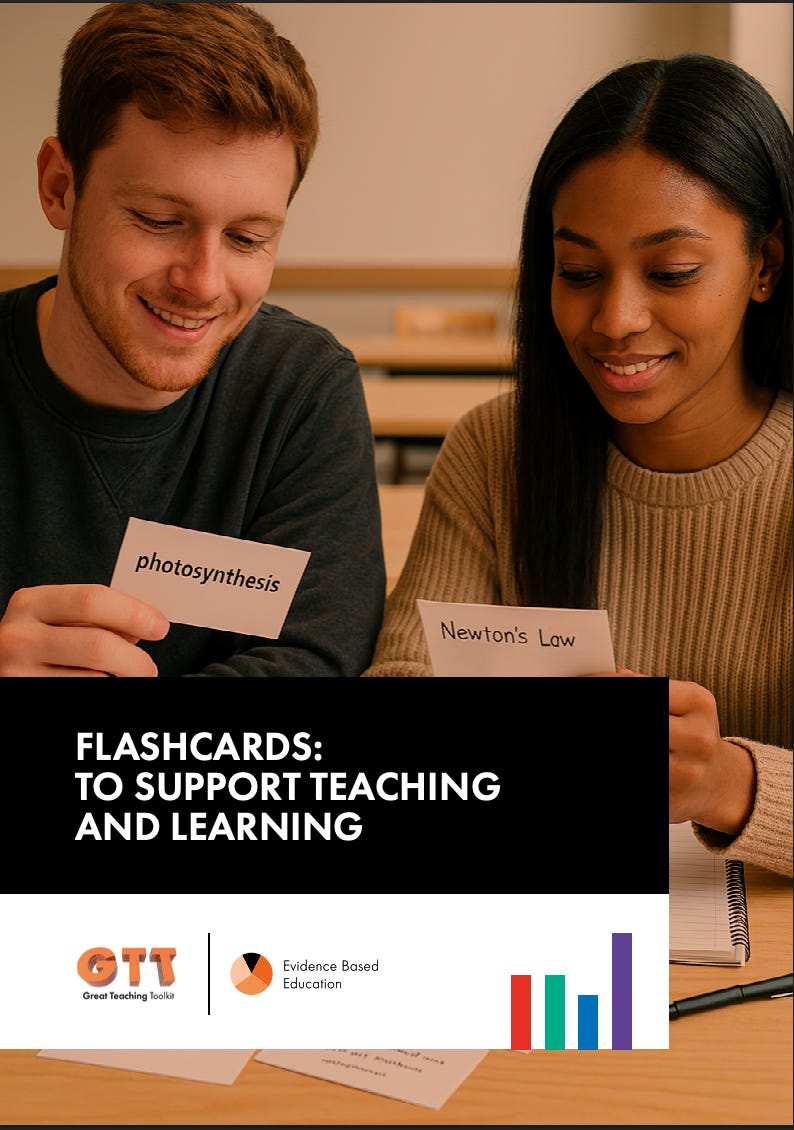
I recently read the flashcards ebook by Kate Jones, and it is well worth attention. It has prompted me to think about bringing flashcards back more formally. What stands out is the insistence on precision, effort and discipline, and the way flashcards are grounded in what we know about memory, retrieval and learning, rather than being framed as a last-minute revision technique to wheel out before a test or exam.
The guide is here and is worth your time:
Familiarity does not equal learning
One of the most damaging illusions in learning is mistaking familiarity for understanding and assuming that recognition equals knowledge that can be reliably recalled.
When students reread notes, flick through a textbook or look back over worksheets, they often experience a sense of recognition. That recognition brings confidence, and that confidence is easily misinterpreted as learning. The problem is that familiarity tells us very little about whether information can be retrieved when it actually matters, without support, under pressure.
Daniel Willingham’s line that “memory is the residue of thought” is a useful starting point. The claim is not that thinking guarantees remembering, but that what we attend to and mentally process is far more likely to be remembered than what we simply encounter or reread.
Questioning matters because it directs attention and forces mental activity. When students are asked to retrieve information, they have to think about it in a particular way. Over time, there is a clear relationship between how often something is retrieved and how accessible it becomes later.
This is what the testing effect captures. Actively recalling information through questions or low-stakes testing tends to produce better long-term retention than rereading or restudying the same material. The benefit comes from the act of retrieval itself, not from feedback alone, although feedback clearly plays an important supporting role.
Whilst I only came across this body of work during the evidence-based shift of the mid-2010s, the idea itself is not new. Early experimental work by Edwina Abbott in 1906 identified what we would now recognise as the testing effect. More recently, a substantial body of research, including the work of Henry Roediger and Jeffrey Karpicke, has demonstrated that retrieval practice improves later recall across a wide range of contexts.
This aligns closely with Robert Bjork’s work on desirable difficulties. Retrieval is often harder than rereading, and that difficulty is part of why it works. When retrieval requires effort, learning tends to be more durable. The struggle matters because effortful retrieval changes how knowledge is organised and accessed in memory. Pulling information out, rather than seeing it again, makes it more likely to be retrievable in the future.
Getting it wrong can help too
We also know that making errors can support learning, largely because the friction they create makes later recall more robust. There is emerging evidence suggesting that deliberately generating errors and then correcting them can have a similar impact on learning to retrieval practice itself.
This only works under specific conditions. Paul Kirschner is clear that deliberate erring comes after instruction, not before. Students need to already know the correct answer for an error to be meaningful. Used carefully, this might involve asking students to generate a believable but incorrect answer and then correct it, or working with errors provided for discussion.
Crucially, students need to understand why this kind of effort matters. Without that framing, many will avoid strategies that feel harder, even when those strategies lead to better long-term learning. Once again, it comes back to struggle. The very thing we are inclined to avoid is often the thing that helps learning stick.
Back to flashcards
I see flashcards as a practical, low-cost way of harnessing these cognitive mechanisms. Used properly, they allow teachers and students to move beyond revision and use retrieval proactively throughout the learning process. Once the ‘how’ is understood, students can work with them independently and with far greater effect.
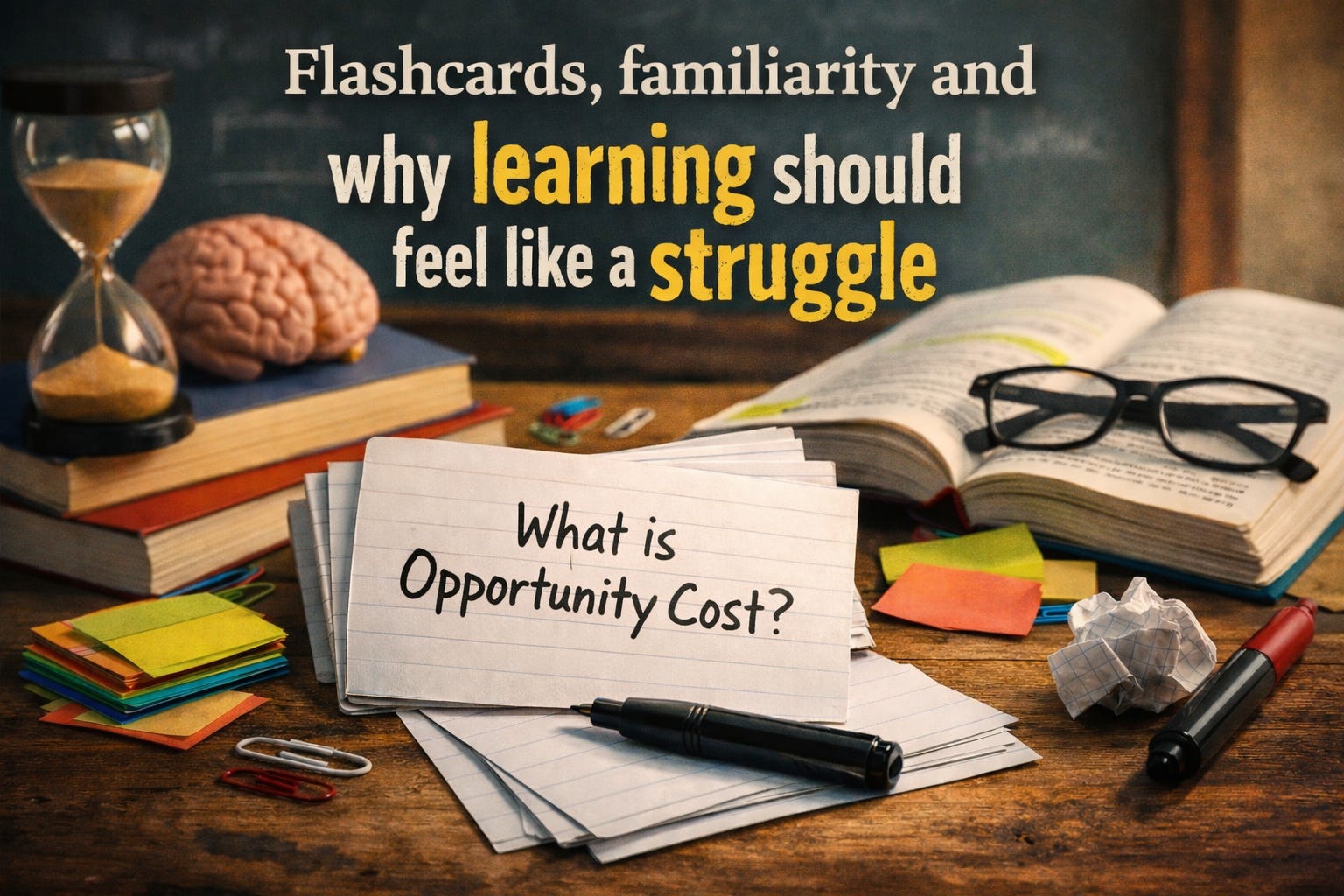
Used badly, flashcards reinforce the familiarity trap. Flip, glance, nod, move on. Students feel productive, but learning barely shifts.
Used properly, flashcards remove the safety net. The term or question is visible. The answer is hidden. The student has to commit before checking. That moment of effort is where deeper learning takes place. This works particularly well with a partner who insists on an answer rather than a shrug, or when students commit an answer to paper before checking it later.
As frustrating as it can be, students need to understand that learning should feel like a struggle. Not confusion or chaos, but genuine, deliberate effort. If retrieval feels smooth and comfortable, it is probably doing less than we hope. When it feels slow, exposes gaps and forces thinking, it is far more likely to be available later.
Flashcards as a curriculum tool, not just revision
One of the strengths of Kate Jones’ ebook is that flashcards are treated as a retrieval tool embedded in teaching, not simply something students do when exams are looming.
How they are built is important. The guide is clear that effective flashcards require:
one idea per card
precise, unambiguous language
clear prompts
answers that can be judged as right or wrong
answers shouldn’t be too hard or to easy
they shouldn’t be used to just read!
making your own can lead to better recall than pre-made cards
Vague or overloaded cards invite misconceptions and false confidence. This aligns closely with the evidence base. Retrieval is not an optional extra and should be part of effective teaching.
Flashcards can be used to support spacing. Flashcards that appear once and then disappear are of limited value. Forgetting, counterintuitive as it sounds, is a condition for learning. When cards return over time, retrieval becomes harder, and that difficulty strengthens memory while slowing the next phase of forgetting. Flashcards can also be used for interleaving, but only when this is done deliberately. Random shuffling is not interleaving. Interleaving works when students must discriminate between similar ideas or procedures. That depends on curriculum sequencing and teacher guidance, not just on the cards themselves.
Implementation is the hard part
This is where James Mannion’s work on implementation is useful. The curriculum is crowded as a standard, with lesson time always tight, and teaching content can already feel like a race. Adding flashcards without removing or reducing something else simply increases workload (for teachers and students) and is unlikely to be very helpful.
In recent years, I have shared guidance on how to use flashcards in whole-year group revision sessions, but have given relatively little class time to building them properly in my own lessons. It is encouraging when students says they have tried the approach and found it useful, but that is not the same as systematic implementation. But since reading more about them, I have been thinking about how.
If flashcards are to be implemented well, it is worth asking a few key questions first, to see if there’s much utility in bringing them in deliberately:
what currently takes time but has less impact than well-designed retrieval?
where could flashcards replace an existing activity rather than sit alongside it?
how will retrieval be revisited over time, not just bolted on at the end?
how will students be taught this process early so cramming becomes unnecessary,
can the process be sustainable and fully independent?
Teaching the process early in necessary. When students learn how to retrieve properly from the start, revision becomes cumulative rather than frantic. That does require time in class, and that is not easy when content pressure is high. The alternative is hoping learning will somehow stick on its own.
Flashcards demand discipline, modelling and clarity. What they offer in return is the potential for far more reliable, independent learning.
Are flashcards worth the effort?
Flashcards are nothing new. They are not clever or innovative. They can be demanding in quiet, unglamorous ways that work in making learning stick
Used with precision, they expose weak curriculum knowledge, lazy revision habits and the false comfort of familiarity. They also give students a way to practise learning independently that research suggests does actually work.
Kate’s ebook is a timely reminder of an underused tool underpinned by solid evidence. I am now thinking about seeing if flashcards are being used across my school and teams. The question, as always, is not whether something works, but if we think it is worth implementing, what do we stop doing to make space?
Flashcards only earn their place when they make learning harder in the right ways. When they do, they can be one of the most honest tools we have.