

I remember having a strong dislike for the strategy units during my studies. Too many theorists, models, loads of frameworks to memorise: critical path, SWOT, Kotter, Lewin, Porter and all that… they all seemed a bit too abstract and detached from reality. Things I had to know for an exam rather than skills that mattered or I thought I’d use for real.
Fast forward a few years, and I’ve done a full 180. Between my MBA, the reality of senior leadership, and now the NPQH, I’ve become a bit of a strategy convert. I used to be operationally focused. In early (and unsuccessful) interviews for senior roles, the feedback was usually: learn to move between the micro and the macro. I see now how central strategy is - not just for businesses, but in leading schools. Understanding strategy and having a strategic toolkit is the difference between living in the weeds and constantly reacting and actually driving your school forward.
A colleague and I will be running a Leadership Pathway soon, taking a deep dive into strategy - change, project management, implementation. The older I get, the more I see that all those frameworks I once thought were pointless are just different ways of thinking things through. Strategy is simply shaping outcomes on purpose rather than by chance. A good one gives you direction and focus. Without it, you drift.
No one really teaches you this stuff in schools (unless you study business or economics). Most leaders have to pick it up later - during a Masters, on NPQs or from a mentor and everyone needs to go through a bit of trial and error.
I’ve made plenty of mistakes running projects. Looking back, I can see where the right approach could have made the work smoother, stickier, more sustainable. I’ve lost count of how many good ideas have faded once the person leading them moved on. This piece pulls together what I’ve learned - the tools, the mindset and the discipline that help turn ideas into something that lasts.
What is strategy?
Strategy is the how. It’s the way you move from where you are to where you want to be. In schools, that means knowing what matters most and keeping that focus alive over time.
At its core, strategy should come back to two things in schools - improving learning and supporting wellbeing. Research (Day et al., 2020; Bennett, 2017; EEF, 2021) points to three levers that make the biggest difference: teacher effectiveness, behaviour and culture, and social and emotional learning. Anything else as a focus means they are all already exceptional, or you might be wasting time, resources and effort looking at developing the wrong things!
But strategy isn’t just about identifying priorities. It’s about communicating them clearly and embedding them so deeply that people feel them in the culture. Every message, meeting and decision either sharpens that focus or blurs it.
I guess a good test of a school’s strategy is how well people stick with it. Does it change every year? It needs steady focus, decisions that stay true to the purpose, and routines that keep everyone pulling in the same direction. Which is where the mission, vision and values come in as guiding forces:
Mission - why we exist, our purpose
Vision - where we’re heading, our future aspirations
Values - our beliefs, how we operate, the principles that guide us
Short-term wins come from the day-to-day graft. Strategy is the bit that builds slowly and compounds over time towards the bigger goal. Without clear anchors, projects feel ad-hoc and the strategy drifts. But when your decisions keep lining up with your mission, the work should last – even when the people change.
Role creep
One thing I know for certain: doing less is always better. It’s one of the biggest traps leaders, especially new ones, fall into. I was the worst... always an ever-expanding list of things to do - and with Parkinson’s Law in play, whatever time I had, the work would fill it. It’s easy to say yes, especially early in your career, keen to impress or chasing a promotion. Resources are always tight and by nature those in education want to help and serve. But role creep – taking on more than the job actually demands – can quickly overburden and burn you out.
Dylan Wiliam captures this perfectly in Leadership for Teacher Learning (2016):
“In my experience, it is hardly ever the case that teachers are doing things that are unproductive. This is why leadership in education is so challenging. The essence of effective leadership is stopping people from doing good things to give them time to do even better things.”
You’d be hard pressed to find a teacher that doesn’t agree with that. Taking on too many initiatives at once is standard for the education sector… but it spreads energy thin. Everyone ends up with bloated to-do lists and working late way, way too often. Piles of marking build up (as it is always the first thing to be delayed) and instead of making meaningful progress, you end up only moving the needle a tiny bit on a few different projects, but nothing really gets done properly.
Strategic Minimalism: less but better
Greg McKeown nails it in Essentialism. His diagram (below) says it all – focus your energy and you move somewhere; spread it thin and you just look busy.
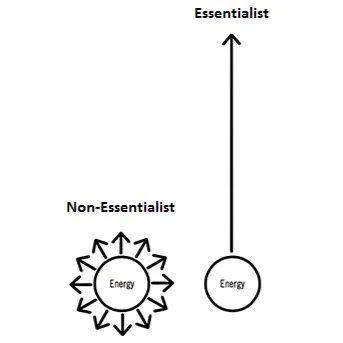
This is where solid strategy, both at whole‑school, departmental and at the individual level is critical. Strategic leadership means being disciplined in what you take on and brave enough to stop things that no longer serve the bigger goal…
Good strategy helps with focus knowing what to pursue and, just as importantly, what to ignore. Having that end goal, a clear vision and then working out exactly what needs to happen to get there. Now it is of course hard to sack everything off and do one thing in a school. But I’ve found, as hard as it might be, that I’m most effective as a leader when I operate with a form of strategic minimalism, and this takes discipline. I reckon that I spent most of my career in education as the “I’ll do it” guy. But over the last few years, I have learnt that you cannot do it all. This means:
Prioritising what will truly move the needle: what projects are critical and what are unnecessary?
Saying no more often is hard but “no” is a muscle.
Keeping the work simple and executable…don’t over complicate: what actions are needed to complete?
I love how Thornhill’s Mr Burton, from Channel 4’s Educating Yorkshire, has simplified pretty much everything into the school’s motto “Be Nice, Work Hard”.
Strategic Models, Tools and Techniques
Thinking about those models and tools that bored me at university…they are what actually enable you to get the work done; bridges to get from where you are to the desired state.
Before starting a project, ask three things:
What’s the real purpose of this work- development, assurance or both?
Is the problem complicated or complex?
What’s the level of readiness - urgency, trust, resources, alignment?
If it’s a clear, contained problem, you can probably use a structured approach like Kotter or Lewin. If it’s messy or cultural, start with sense-making frameworks like Cynefin or Stacey and layer structure in later. I won’t go into those methods now, but there are two failure patterns worth avoiding:
Measurement becomes the target when metrics replace meaning, practice can narrow and the real learning disappears. We all know the phrase what gets measured gets managed but it is good to keep, weighing the pig won’t make it fat in the back of your mind.
Happy talk kills urgency a positive culture can mask underperformance. Without honest conversation, change can be slow to take hold. This is dangerous, and while I won’t be touching on psychological safety here, it’s worth remembering that candour without care can do as much harm as silence. The real skill lies in creating spaces where people can speak the truth, be heard, and still want to stay part of the work – and aren’t punished for it. There’s nothing good about being the Emperor in the story about the Emperor’s new clothes.
Once you’ve diagnosed the challenge and chosen your approach, the next step is turning strategy into movement.
Methods that travel well
These are the tools I keep coming back to when planning or leading projects. They’re easy to apply, but powerful enough to build real momentum.
Kotter’s 8 Step Change Model
This one gets thrown around a lot, but it’s still one of the best starting points for structured projects, or at least that’s what my Master’s lecturer told me. It seems pretty popular, too with most leaders knowing about it. Apart from in my academic assignments, I don’t tend to follow it step-by-step - schools are messy, but I do reckon the first few stages are gold for most projects when there is some form of change involved. Creating urgency, building a guiding coalition and then creating and communicating a clear, believable vision can all determine the success of a project.
I’ve seen plenty of initiatives skip straight to the launch - a quick briefing presentation informing of new systems - without fully investing in the early groundwork. Teachers need to feel the reason for the change.
The coalition piece matters, too. You need the right mix of credibility, influence and drive. When respected teachers are genuinely behind an initiative, it changes everything. They carry weight in the staffroom and help keep the work alive as everyone starts to move on to the next thing.
I also think the short-term wins Kotter talks about are great opportunities to grab some low-hanging fruit - things that show quick, visible progress. They’re worth planning deliberately. When something works fast and people can see it, it builds belief and changes the narrative in the staffroom. Anything that reduces friction, saves time or clearly helps students learn is the best kind of early win to help build momentum.
Whilst there are eight steps for a reason, the danger is in treating Kotter like a straitjacket. It’s not. For me it works best as a loose framework to give direction. Use it as a guide, not a recipe to follow to the letter.
Timelines and planning tools
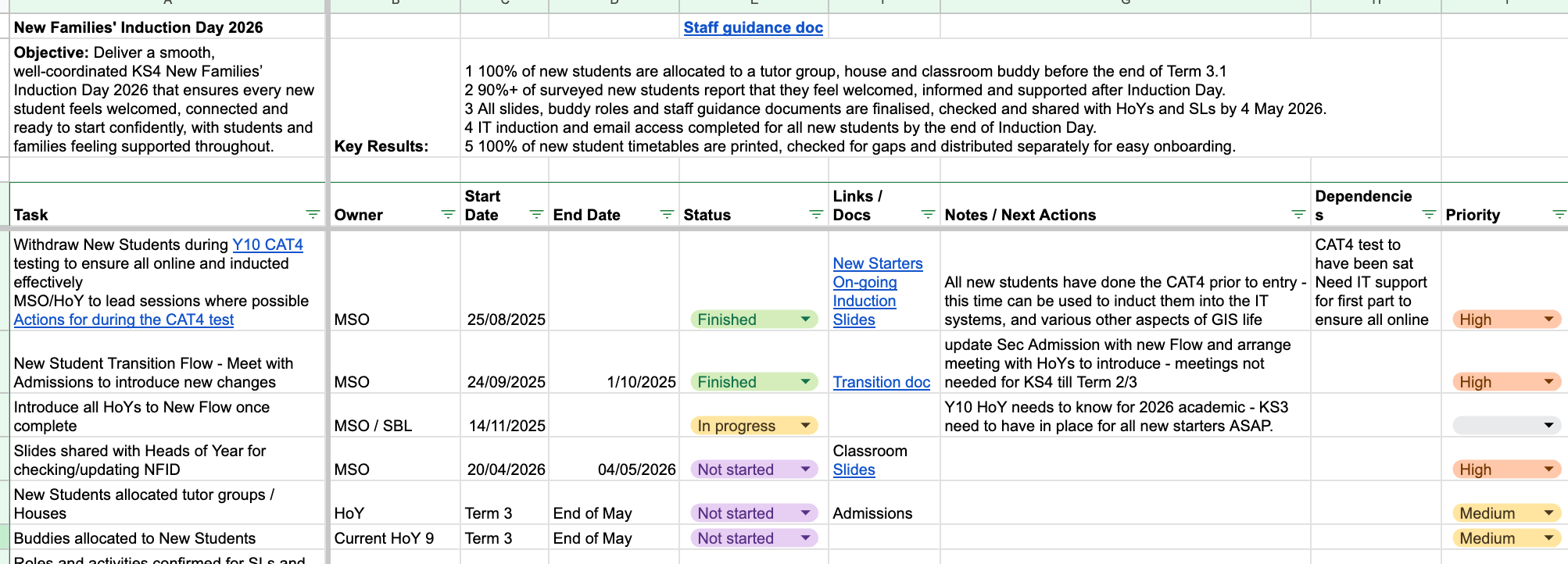
For every project, I keep one master sheet with a simple timeline and checklist. I work backwards from the delivery date, plotting the key steps and linking the documents, slides and forms I’ll need along the way. Each tab covers one project, with an overview tab that brings everything together in one view. It’s not fancy, but it works – and the more responsibilities I’ve taken on, the more I rely on it.
Speed SWOT analysis (Exactly the same as a SWOT just done faster)
Probably one of the most well-known tools and an incredibly simple way to understand context. Using it surfaces the internal strengths and weaknesses and the external opportunities and threats as perceived by those you ask, which then helps spark discussion. A great tactic is to run a Speed SWOT with a cross-section of staff, by sending out a short google form. Keep it short, gather honest views anonymously and share the themes back quickly, using AI to analyse. The learning and progress comes from the fact it is anonymous and so the potential tensions get highlighted rather than the less-than-natural consensus that can sometimes come when people collaborate on a SWOT round a table.
OKRs (Objectives and Key Results)
A clear, simple format to provide focus. I think these are needed for every project you lead on. Set one objective - what do you actually want to achieve - and two to five measurable key results that track progress as you go.
Below is an OKR example from when we introduced the Deliberate Device Use System in November 2023. We didn’t hit every key result, but we got close, and it gave the work structure, direction and a way to measure progress that went beyond good intentions.
Objective: Embed a culture of deliberate, mindful device use across Secondary so that technology enhances learning without disrupting focus, wellbeing, or relationships.
Key Results:
100% of students are briefed on the Responsible Use Policy during the first week after half-term and can articulate key expectations in follow-up tutor discussions.
100% of teachers contribute by collecting devices seen and hand them to the Secondary Office
100% of inappropriate device use incidents are logged and followed up with a restorative conversation (tutor) within 48 hours.
Student voice indicates a 20% increase (from baseline) in self-reported ability to manage device use responsibly.
Parents receive clear communication outlining the policy, rationale and support channels before implementation and rollout.
Pre-mortem
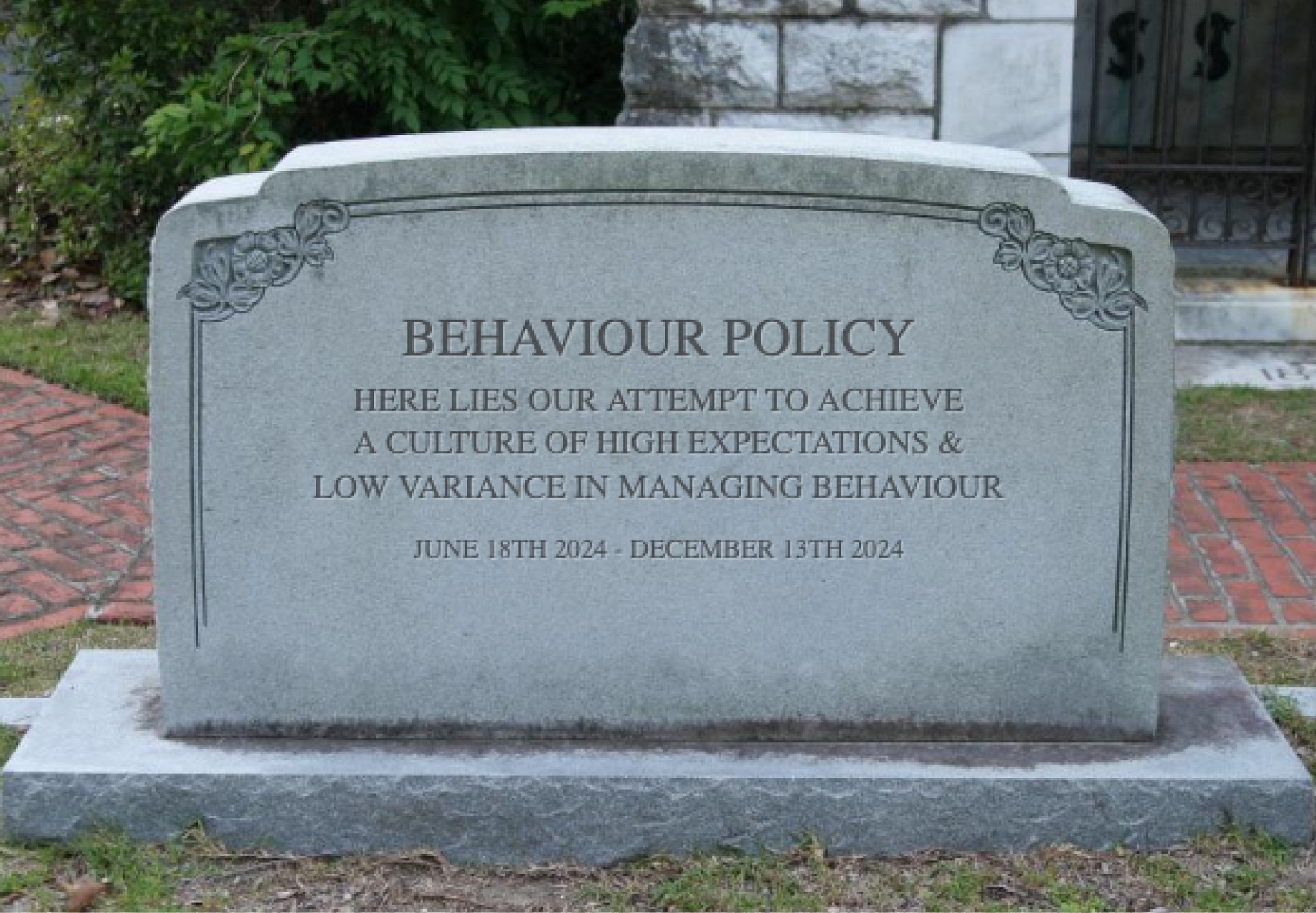
Probably my favourite tool. I’ve used it for big initiatives like improving punctuality and implementing a new behaviour policy. Before launch, gather the team involved and ask them to imagine the project has failed by a set date. Then ask: What went wrong? What was missed?
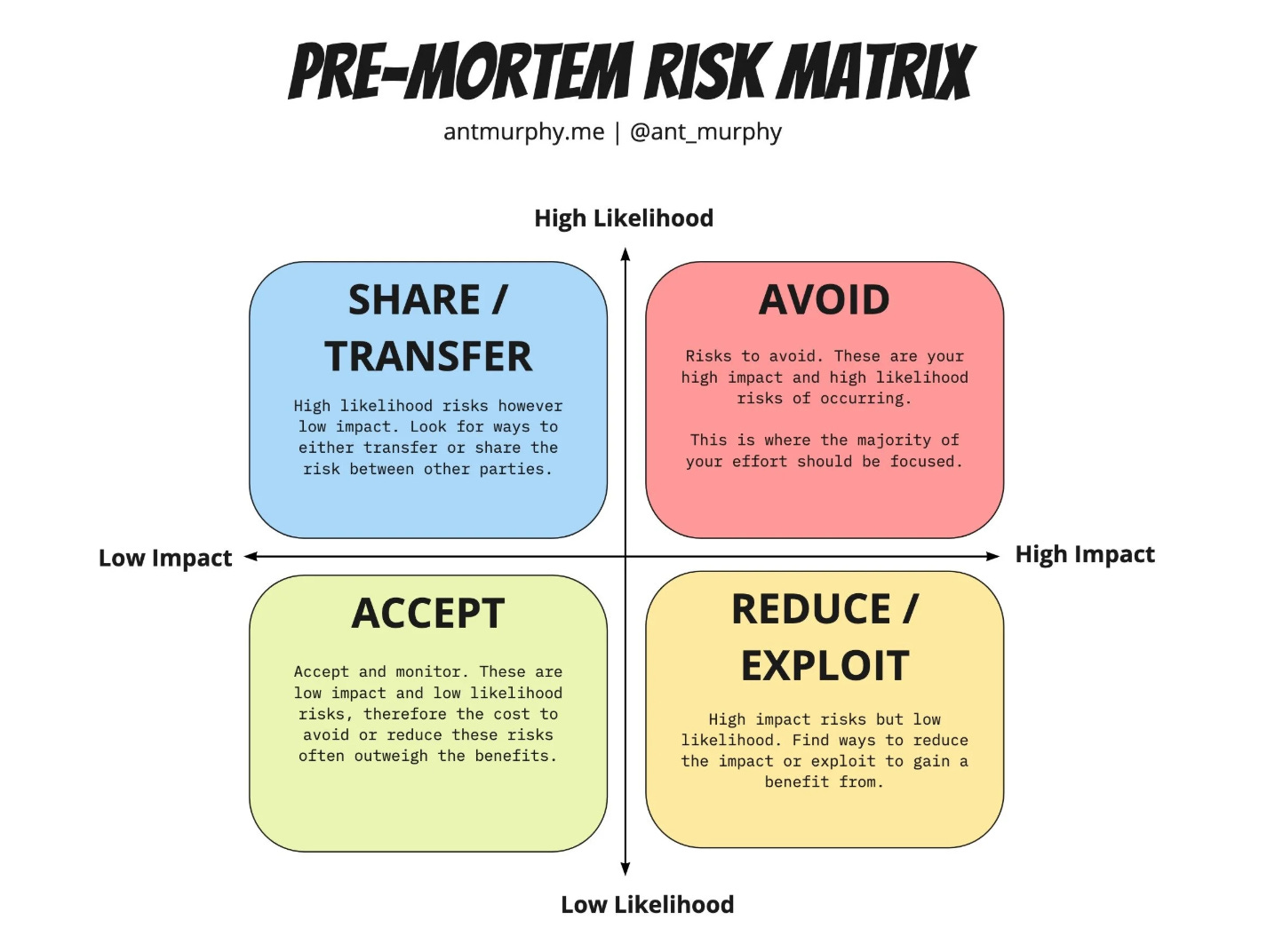
Teachers are brilliant at this part. It flips the mindset from optimism to preparation and surfaces risks early. I then like to use the Risk Matrix from AntMurphy.me to map risks and then move the session towards planning how to reduce the most likely and high impact risks.
Inversion
More of a mental model than a tool - basically a lighter version of the premortem. Charlie Munger explains it perfectly here: most people ask “How do I achieve success?” Instead, he says it’s often wiser to flip the question and ask “What would guarantee failure?” - then avoid those things.
Two Munger inspired examples:
If you want a happy life, don’t ask “How do I become happy?” Ask “What would make me miserable?” and stop doing those things - envy, resentment, poor health, bad relationships.
In business or education, instead of “How can we make this succeed?”, ask “What could ruin this?” and design around the answer.
Inversion thinking works by starting from failure to make better decisions. It forces realism and helps you see blind spots. Take your OKRs and ask: What should we avoid at all costs? or If this failed, why would that be? Sometimes it’s easier to spot what to stop than what to start.
Stakeholder analysis
Use this right at the start of a project - before decisions are made or messages go out. It helps you see who’s affected, who influences, who might block it, and who needs to own it. Decide early how to involve or inform each group so nothing catches anyone off-guard later.
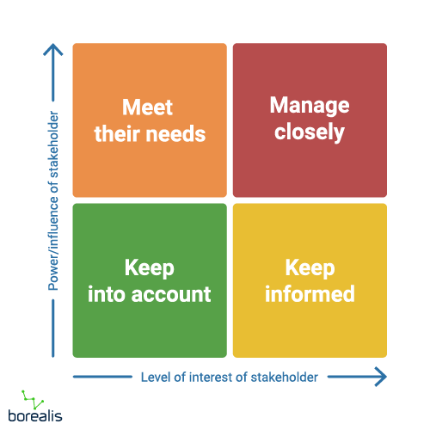
It’s also a useful tool for deciding who to include in a premortem or who needs to be consulted or looped in at different stages of the work. I’ve found it especially valuable for projects that cut across teams or roles, like behaviour or attendance systems. When people see how a change connects to others, it can help reduce resistance and increase ownership.
Eisenhower matrix
I first came across this years ago through Covey’s 7 Habits and now have the matrix drawn on my whiteboard in front of my desk. I use it to sort next actions for live projects into urgent/non-urgent and important/unimportant. As a mental hack, I only keep the top row - the Important stuff - and split that into urgent and non-urgent tasks. It keeps things simple. The aim is to stay on top of the non-urgent important work so that, technically, nothing ever becomes truly urgent.
I’ve built in a couple of recurring time-boxed Strategic Time sessions each week, where I try to only work on the important/non-urgent tasks, which helps me try and keep all the important things out of the urgent category.
Time-boxed sprints
These are short bursts of focused work with a clear outcome. I use them mainly for strategic projects - the kind that are important but not urgent, like the upcoming IGCSE options process. I’ll usually book a private room in the library, set a timer and work in Pomodoro-style blocks.
These sprints sit in my scheduled Strategic Time slots each week. Having a defined window to concentrate reduces interruptions and stops the big, long-term projects from slipping down the list, and the timer keeps me honest.
Once a week, I have a focused sprint while I do a GTD-style weekly review - a quick Mind Sweep, update project timelines and plan the following week’s operational and strategic work. Any time left goes on clearing my Next Actions list, which usually means lesson planning or marking.
Implementation matters (probably most)
Most school projects fail not because the idea’s bad, but because the implementation is weak. We talk about what to do far more than how to do it well.
The NPQ Headship Framework nails this. Implementation is slow, deliberate work - testing, adjusting, learning. It’s about pacing change, removing friction and staying close to the people doing the work. When I dug into this as part of a recent NPQH assignment, five themes stood out that sum up what effective implementation really involves:
Diagnose before you decide
Start with the problem, not the solution. Talk to people, look at the data, find the friction. Don’t start fixing before you know what’s broken. Use a clear, robust process to identify what actually needs changing.
Focus on fewer, better priorities
Depth beats coverage. Evaluate honestly and be brave enough to stop what’s not working. Back one or two things and stay on them until they stick.
Plan deliberately, then adapt
Implementation is a process, not a moment - and certainly not just a launch. Use timelines and stakeholder maps to plan in stages, set review points, and adapt as things change.
Match the approach to the context
Context decides whether a good idea works. Check readiness, capability, trust and timing - then adjust the pace and scale of change to fit reality on the ground.
Build climate and capacity
Change depends on the environment people work in. It lasts when people feel safe, trusted and supported. Distribute leadership and keep attention on the work long after the initial buzz fades.
Bridging the gap between ideas and execution
The hard bit of strategy isn’t having ideas. Every staffroom is full of them. It’s choosing which to back-and getting them to actually happen.
That takes clear, consistent communication. I used to believe you couldn’t over-communicate. Turns out, you probably can-but you just have to make it worth hearing. Keep the message tight, consistent and anchored to purpose.
These questions can help at any stage of a project:
Do staff know what we’re trying to do and why it matters?
Is their role in it clear?
Are we reinforcing the message in briefings, meetings, feedback, 121s, and in our day-to-day actions and expectations?
It’s pretty old now, but I still love the Netflix Culture slideshow. Early in the deck it says a company’s values have nothing to do with the nice-sounding statements on the wall. It goes on: “Values are shown by who gets rewarded, promoted, or let go.” That line stands out. It’s a reminder that culture and strategy aren’t what we say they are – they’re what we tolerate, reward and repeat, and basically what we do.
If you want to see a school’s real strategy, don’t read the plan. Watch what people do on a Tuesday morning when no one’s watching.
In closing…
…strategy’s just about doing things on purpose - knowing what matters, doing it well and seeing it through. To summarise this massive think-piece:
Do less, but do it properly.
Use the tools that help you think clearly.
Plan it out, get people on board, and keep the message steady.
Keep it anchored to purpose, not trends.
Mostly though, strategy is about improvement and that comes through turning up, doing the work, building relationships and learning as you go. That’s how things actually change.
Excellent article, Mark and provides an opportunity for self-review as one reads. I've been involved in a few strategic plan creations now but my most recent has been the best executed and most memorable (overall success will be in the next few years). Two key points to offer:
1. Involve as many voices as possible from your community in a sincere and genuine way. My objective by the end is to ensure every community member reads the plan and feels and sees their own words and hopefully have a positive emotional reaction to the road ahead.
2. Someone's job should be strategic coordination. Full time. That person loves and breathes it and holds others to account. It's too important to think about just some of the time.