

Most of our students work hard, but working hard and working effectively are not the same thing, especially when it comes to revision. The difficulty is that revision is rarely taught explicitly, and with so much curriculum content to cover it is often left vague or assumed. The result is predictable. Without knowing how to revise, even motivated, capable students end up relying on guesswork, wasting time and underperforming under pressure.
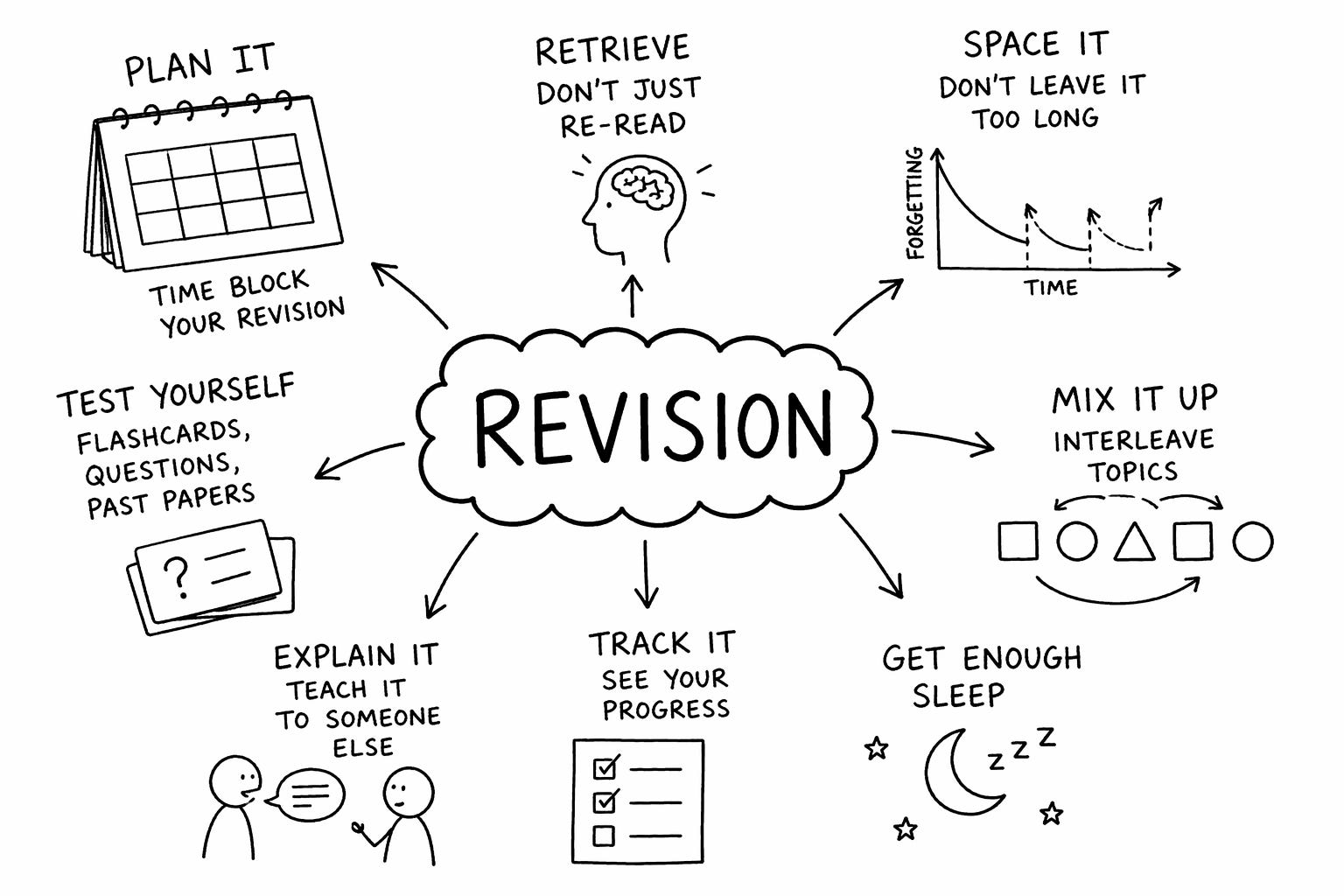
A few 121s with students before the mock exam season a few Januaries ago confirmed this. When I asked what revision looked like, the answers were pretty much the same: reading through notes, revisiting old feedback, highlighting classwork, rereading the textbook, completing past papers and waiting for a teacher to respond or going through papers with a tutor. Some of this has value. Much of it does not.
That gap, between effort and effectiveness, is no small detail. It is the same exam-prep experience for most students. We expect them to perform in high-stakes conditions having never really shown them how to prepare for those conditions properly.
This piece draws on what we know about how memory works and combines it with what we understand about habits and planning, translating both into strategies students can use immediately. These are not guarantees, but they are grounded in decades of replicated research and provide a far more dependable approach than instinct or preference. And they’ve worked for many of our students.
Why most revision doesn’t work: the cramming problem
Most students, when asked honestly, will admit to cramming before a test. The pattern is generally the same: focus hard the night before, memorise key terms and definitions, perform reasonably well the next day, and then move on. The reason this persists is that it can appear effective…in the short run.
Hermann Ebbinghaus showed that forgetting is rapid and front-loaded. Without revisiting material, retention drops sharply within the first day and continues to decline thereafter. What he also demonstrated is that each return to that material slows the rate of forgetting, gradually strengthening it over time. The issue with cramming is not that it produces no learning, but that it produces learning that does not last.
What makes this harder for students to recognise is the sense of familiarity that comes from rereading. When content looks recognisable on the page, it creates the impression of knowing. Robert Bjork’s distinction between storage strength and retrieval strength explains this. Information can exist in memory without being accessible when needed. Under exam conditions, it is retrievability that counts, not recognition.
This is why performance in the moment can be misleading. A completed task with notes nearby or a piece of work produced in comfortable conditions tells us very little about whether knowledge can be recalled independently, applied flexibly or sustained over time. The goal is not short-term success but knowledge that remains available when it is needed.
What actually works: the science of learning
A consistent body of research points towards a small number of approaches that improve long-term retention, and although these ideas are now widely referenced and used by (many?) teachers, they are still not widely used with any discipline by students.
Retrieval practice is one of the most useful processes. Testing yourself on material strengthens memory far more effectively than rereading it because it requires information to be brought to mind rather than recognised. If students are serious about revision, they have to move beyond looking at information and start trying to pull it back out.
Spacing builds on this. Returning to material after some time has passed, rather than revisiting it immediately, produces more durable learning because it requires effort to retrieve after sufficient time for a bit of forgetting. That effort is part of the strengthening process. Revision that feels harder because some forgetting has taken place is revision that is doing its job.
Interleaving adds a further layer by mixing topics and question types rather than working through one area in isolation. Students are required to discriminate between concepts and select the right knowledge for the task in front of them. It is more demanding, but it reflects the conditions of the exam far more closely.
Self-explanation takes this further. When revising in economics, for example, we often ask students to treat each multiple choice option as a true or false proposition and explain fully why in either case. That process exposes whether they actually understand the concept or have simply learned to spot the right answer. It slows them down, but it also sharpens their thinking in a way that simple recall cannot.
Worked examples and scaffolds play an equally important role. Strong revision, whilst ultimately aiming for independence, needs to begin with some guidance. Model essays, clear structures/frameworks and worked solutions provide a reference point for what strong thinking looks like. Removing that support gradually, rather than all at once, allows students to build towards independence rather than struggle blindly towards it.
Another of Bjork’s ideas, desirable difficulties captures much of this. Learning that requires effort tends to last longer than learning that feels straightforward. Students are often drawn towards what feels smooth and fluent, when what they need is something with enough resistance to strengthen recall.
Two further points are worth stating directly. Attention is a prerequisite for learning. If a student is distracted, little is encoded in the first place. And as Daniel Willingham has argued, memory is the residue of thought. What we remember is closely tied to what we have had to think about.
If you did only two things
If a student wanted the greatest return for the least complexity, there are two habits that would carry most of the benefit.
First, retrieval practice. Stop rereading and start testing. Try to bring information to mind without support, then check and correct.
Second, spacing. Return to the same material multiple times across days and weeks rather than in one concentrated block.
Those two, done consistently, outperform almost everything else. Everything that follows refines and strengthens them, but without them, revision rarely holds.
Time blocking and scheduling: building the system
Knowing what works is only useful if it translates into consistent action across weeks and months.
Tasks left on a to-do list rely on motivation in the moment, whereas tasks placed in a calendar become commitments. A scheduled block removes the need to decide what to do and when to do it. It allows the student to begin without negotiating with themselves first.
In practice, this means being precise. “Revise econs” is too vague to act on. “Macroeconomics: International Trade, past MCQ questions, 60 minutes” is not. If something disrupts the plan, the block is moved rather than abandoned.
I found it annoying how so many students resist this level of structure, preferring to retain flexibility. In reality, that flexibility often turns into drift. Without clarity on what is being studied and when, coverage becomes uneven and gaps remain. Students I mentor will often push back here, and it isn’t until they fully commit and see how it works when they live by their schedule that they recognise how powerful it can be.
This is also where interleaving operates across time, not just within a session. A student might schedule one topic on Monday, another on Tuesday, then return to the first later in the week in a different form. That pattern spaces the learning, mixes it with other material and prevents the false confidence that comes from over-familiarity.
We have started to teach much of this more explicitly over the last few years. Earlier in Year 11, during tutor time, we now run short carousel sessions where students are shown what effective revision looks like. Retrieval, spacing, self-explanation, planning, all in small, practical blocks. Without making time, far fewer students would be effective in their revision. You have to remove the assumption that students will work this out for themselves.
To support this, Heads of Fac have contributed to central schedule that breaks all subjects into topics and tracks each return to them over time. The aim is to revisit each topic multiple times across the revision period, using a range of approaches. The value lies not in repetition alone but in strengthening access to the knowledge so that it can be used under pressure.
Getting the level of difficulty right
One issue students run into quickly is getting the level of challenge wrong.
If everything feels easy and most answers are correct, the work is not stretching memory enough. If everything is wrong, the approach is not working and needs adjusting. Strong revision tends to sit between those two points, with a high success rate early on and increasing difficulty over time.
That might mean starting with structured questions or supported tasks, then moving towards more demanding retrieval and finally timed exam conditions. The key is not to sit in one place for too long. Revision should evolve as knowledge strengthens.
Techniques that work in practice
The Pomodoro Technique provides a simple structure for focused work. A 25-minute block followed by a short break creates a contained period of attention that makes starting easier without lowering expectations.
Mind-maps can be effective when used as a recall task. Review the material, put it away, reconstruct it from memory, then check for gaps. What is missing becomes the focus for the next session.
Flashcards allow for repeated self-testing, with attention directed towards what is not yet secure. Mixing topics within a set introduces variation and forces the brain to switch between ideas. I wrote more about flashcards before, here.
Worked examples can be used actively by studying structure, removing parts of the scaffold and attempting parallel responses independently. That gradual withdrawal of support builds competence far more reliably than jumping straight into full answers.
The image I come back to with students is the jungle. When they first encounter a topic, the knowledge is in there somewhere, but there is no clear path to it. The first attempt to retrieve it cuts only a rough trail. A second return clears a little more. Leave it too long and the growth starts to reclaim it. Return again and again, at spaced intervals and in different forms, and eventually the path becomes one you can rely on. That is what revision is for. Building a route back to knowledge that will still hold when the pressure is on.
Past papers: track, mix and mark
Past papers become increasingly valuable as exams approach, but their impact depends on how they are used.
For multiple choice papers, tracking scores over time allows patterns to emerge, but the real value comes from interrogating each option and understanding why it is right or wrong. That process reveals misconceptions and directs future revision.
For extended responses, self-marking against the mark scheme encourages closer attention to what is actually being rewarded. Examiner reports add another layer, showing the patterns that repeatedly cost students marks.
Mixing topics within practice sessions ensures that revision reflects the demands of the exam rather than the comfort of single-topic study.
How parents can help
Parents cannot revise for their children, but they can influence whether revision happens in a structured way.
Asking to see the plan, checking what has been covered or testing a small number of flashcards provides accountability without taking over the process. Even sitting with a student for the first few minutes of a session can help overcome the barrier to starting.
Equally, parents can also control device use/access, monitor sleep and support with nutrition, all of which can have a major impact on retention at any time, but especially when revising.
The aim is to provide presence and structure rather than pressure.
Once students have a clear system, the change is often immediate. Work becomes more focused, progress is easier to see and the sense of control increases.
Most students do not need to care more. They need to know how to revise in a way that justifies the time they are putting in. Once that becomes clear, revision stops being something they endure and starts becoming something that returns on their investment.
Thanks Mark, a timely reminder for us to reflect upon how best we can optimise support for our students and embed effective habits and routines - not just for the purpose of exams!
Your second line ("The difficulty is that revision is rarely taught explicitly") is something that resonated as we tend to assume that somebody else has taught them these things. This reminded me of this extract from What Works What Doesn't (Dunlosky et al 2013), "Students are not being taught the best strategies, perhaps because teachers themselves are not schooled in them" - this is why I strongly believe research-informed T&L CPD is KING.
https://wcer.wisc.edu/docs/resources/cesa2017/Dunlosky_SciAmMind.pdf
I enjoyed this, thank you. My word of caution would be that teaching students about effective study strategies and helping them block time and stuff is important, but it is in no way close to sufficient for them actually *actioning* effective habits. It's much more important to just "flood the zone" with effective revision, and leave them very little room to make their own decisions. If you do, however much you have trained them they will still default to watching YouTube videos in their room!