

Coaching is a popular, some might say essential, tool in a leader’s toolkit. Most leaders these days will have experienced coaching as both the coach and coachee. And not without good reason. Coaching is a proven way to develop others, build capacity and encourage problem solving. Coaching has been identified as one of the more common and successful leadership styles, along with the more established styles of educational leadership: instructional, transformational, transactional and collaborative etc.

Defined, coaching is a concept and practice whereby a set of skills and processes are aimed at helping individuals clarify their goals, reflect on challenges and discover their own solutions. It’s used in various contexts, particularly in personal development, sports, education and the business world, to facilitate growth and improved performance. It is usually conducted in a 121 format and in a formal setting with clear and agreed objectives and timeframes that are clearly established before beginning.
Now, when I talk about coaching as a leadership style, I am referring to a leader’s deliberate choice to embed some of the coaching techniques into how they interact, manage and develop their team. This type of coaching is newer to me and is less of a one-off interaction with a deliberate purpose and is more of a philosophy or ‘way of being’ as leader in order to meet results, develop team members or drive performance. I don’t remember hearing much about it during my days studying (business and management) or until considerably more recent in the world of education. In fact it wasn’t until I left the UK in 2009 that I think I was exposed to it.
‘Coaching’ vs ‘Coaching as a Leadership Style’
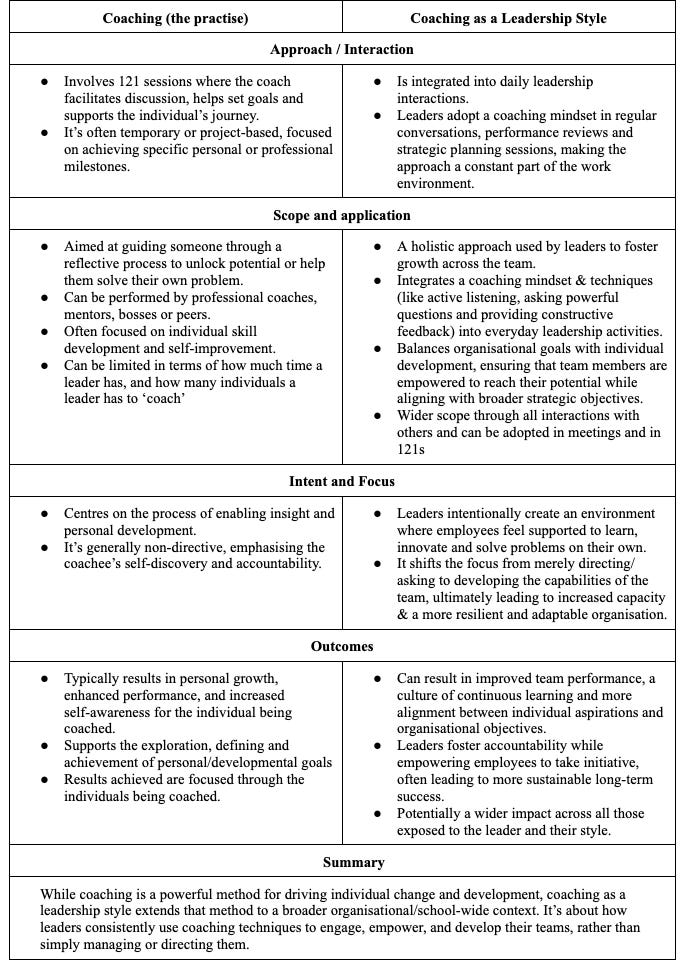
This Cloverleaf post gives a great overview of Coaching as a Leadership Style. And, for my own clarity, I have tried to distill the key distinctions between how I understand coaching and the coaching style of leadership (I have no idea how to make a table in Substack so I’ve pasted in a screenshot from Google Docs 🤷♂️):
On a personal level, I’ve been fortunate to be coached by some excellent leaders over the years. I’ve also experienced some less-than-effective coaching, too. There was something of a surge in coaching a few years back when line management meetings were rebranded as ‘coaching meetings’. Suddenly, everything had to be more coach-like. Problems brought into the meetings were smashed back as questions, and leaders - probably with only minimal training - started working through the GROW model as if it were gospel.
The intention was good, but the execution often wasn’t. Coaching is a skill. Done well, it doesn’t feel like it’s being done to you. But with an inexperienced coach, you can usually tell when you’re being coached - rigid models being stuck to, pre-planned questions they keep looking down at, a mechanical delivery, they feel like they are waiting to ask their next question… If it doesn’t feel natural, don’t be surprised if the other person switches off.
I remember a colleague booking one of our coaching slots with me a good few years back. Before we began, she made it very clear: “I do not want to be coached!” She said she found coaching annoying and came to me as she just wanted some space to talk through a problem and get some advice. Fair enough. Any experienced coach will tell you - you can’t coach someone who doesn’t want to be coached. Sometimes, people don’t need a model, a process, or a reflective question. They just need a conversation and some clarity.
Interestingly, that meeting still ended up feeling a lot like one of my usual coaching sessions. I asked some of my ‘normal’ questions, she did some thinking, I paraphrased, asked a few more. At one point, I gave some advice that she had directly asked for - but in the end, the solution she left with was something she came to herself and she left energised (I think). At the time, I didn’t register what had happened. But in hindsight, I can see it more clearly: coaching doesn’t need to be announced. It’s not a performance. It’s not a posture. It is really just a good conversation that is specifically focused on one person with some some really good, well-timed questions and loads of listening.
Some of the best leaders (who may or may not have intentionally coached me) that I’ve worked with have a kind of resting-coach-face. They lead with curiosity, calm and clarity - and ask questions that make you better, whether they mean to or not.
I used to find coaching frustrating. Early in my career, I sat through a handful of “coaching” conversations that I hadn’t asked for. Sometimes, like my colleague years later, I just wanted a straight answer but instead got questions that felt like a game of “guess what’s in my head.” It was frustrating. I would switch off thinking, “just tell me what to do and I’ll do it… I’ll grow from there.”
For years, I had a pretty cynical view of coaching. I saw it as a bit cheesy, a way of not doing your job as a leader. Back then, as a middle leader I was happy giving advice, solving problems and making things easier for my team. That felt like leadership to me.
Then, something changed.
I worked with a leader who never asked if they could “coach” me. They never labelled it. But whenever I brought them a problem, the conversation would unfold the same way - just a few simple, well-placed questions that helped me unlock the next step. No framework. No script. Just presence and precision.
One question in particular has stuck with me. I would almost always be asked it when bringing an issue through their door : “What are you thinking?”
So simple. Yet every time, it worked. I’d shift from thinking about a problem to actually thinking about possible solutions. I’d talk it through, get clear and generally walk out feeling focused and more confident - often completely unaware I’d just been coached. After a while, I knew what I was going to be asked, and would go in prepared to share the options of solutions, as well as the problems. And guess what I’d hear… “so, which one are you thinking?”
That was the kind of leadership I wanted to emulate.
At the time, I’d already done some coaching training. I had the frameworks, a couple of certificates and a bank of useful questions. But I’d kept coaching in a box - only using it when someone asked or when I’d gained permission. I hadn’t yet integrated it into how I led others.
That started to change when I worked with this particular leader - and it was around that time that I discovered The Coaching Habit by Michael Bungay Stanier. I loved it. It gave me something I didn’t know I needed: positioning. Practical, sharp questions. A mindset. A way to lead differently.
What clicked for me was the idea that decent coaching can simply come from better conversations. It’s about asking the right question at the right time, in a way that feels natural - not mechanical - and then listening for way longer than feels comfortable (still the hard part for me). That’s what I began working on. Nothing formal or forced - just trying to weave The Coaching Habit questions into my daily conversations, and building in more space for listening, in a way that doesn’t even feel like coaching.
The Coaching Habit gave me seven questions that felt right for my voice. Maybe it’s because Bungay Stanier is an Aussie, but they just roll off the tongue for me - even though they’re technically scripted. I often tweak them to suit the person or situation, but their essence holds up. Alongside my old boss’s go-to - “What are you thinking?” - these have slowly become part of how I speak, lead and support others, often without even realising.
Here they are:
What’s on your mind? (the kickstart for every 121 now)
And what else? (to expand thinking)
What’s the real challenge here for you? (to focus)
What do you want? (to clarify)
How can I help? (to avoid rescuing and put them in problem-solving mode)
If you’re saying yes to this, what are you saying no to? (to force prioritisation)
What was most useful for you? (to reflect and force them to state what has helped)
These questions aren’t magic, but they do work because they hold space, invite ownership and keep me out of rescue mode…and they sort of feel natural to move through - I won’t always use every one of them in a conversation, but more often than not, they seem to flow from one to the next, for me anyway. I recently found myself going through them with my daughter in a taxi ride home from school after she opened up about an issue she’d had that day. They worked there, too!
These days, I’m working hard to keep coaching woven into how I lead. I don’t see it as a service I provide, but as a posture I try to hold. I’m still very much a work in progress (especially on the listening part - my advice monster is ripped, having had way too many reps), but I’m more aware now. I’ve come to believe the real measure of leadership is the leadership you create in others. If I can help people grow their independence, agency and problem-solving, then maybe I’m leading in the right way - and so far, that seems to be true. Whether it’s stealth coaching or just having a bit of a resting-coach-face, I’m good with that.