

Every technological revolution changes what is scarce.
The printing press made books abundant and literacy valuable.
The Industrial Revolution made manufacturing cheaper and shifted value from production towards design, management and innovation.
The internet made information abundant. Knowing where to find it became less valuable than knowing what to trust.
It’s no surprise that artificial intelligence appears to be doing something similar to intelligence itself.
Over the past few weeks I’ve been listening to Craig Barton’s excellent AI series with some incredible guests including Kris Boulton, Carl Hendrick, Adam Boxer and Dylan Wiliam. Each approaches AI from a different perspective. They disagree on plenty and I learnt a great deal from the conversations. The Alpha School chats are very interesting, but I probably came away with more questions than I started with.
One question I keep thinking about is:
If AI makes intelligence increasingly cheap and easy to access, what should schools actually be doing?
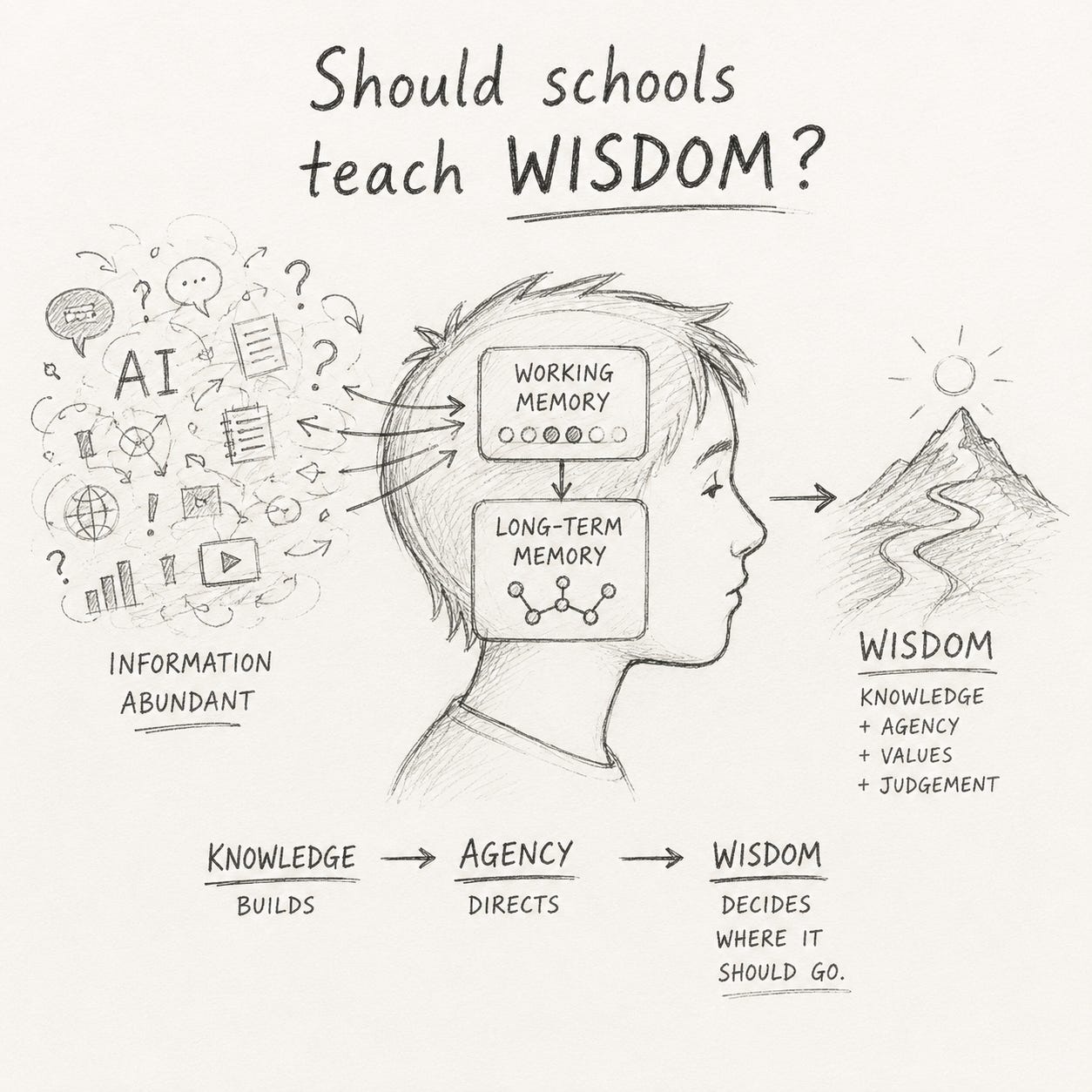
You see plenty of attempts to answer that question across the edu-socials every day. AI can write essays, generate code, diagnose disease and plan lessons. The conclusion is often that schools should simply pivot towards whatever AI cannot yet do, or integrate AI into classrooms as quickly as possible. Coding, prompt engineering, adaptability and generic skills like critical thinking or problem solving inevitably appear somewhere on the list.
There is nothing inherently wrong with those suggestions. Schools should be thinking seriously about all of them. But they all start from the same assumption: that the purpose of schooling should be defined by AI’s current capabilities.
I’m not convinced that’s the right place to start.
The science of learning hasn’t changed because AI exists. Human memory still builds knowledge. Expertise still depends on richly organised long-term memory. Judgement still depends on what we know.
So perhaps the better question isn’t, “What can AI do?” or even, “What can’t AI do?” It is, “If AI changes what is scarce, what becomes more valuable for humans to develop?”
For me, I keep coming back to wisdom.
Intelligence is becoming a commodity
As an economics teacher, there’s a familiar pattern. When supply increases and something becomes abundant, its scarcity value changes. No one is really paying for access to information anymore. We do pay for interpretation, though. We no longer pay simply for manufacturing, but we will pay for design, brand and trust.
If access to intelligence becomes increasingly abundant, the premium shifts elsewhere: towards agency and, ultimately, wisdom.
AI may make access to intelligence cheaper, but it cannot shortcut the knowledge humans need to think well.
Therefore, even in a world with AI, knowledge remains the engine…. Agency puts it to work. And then I see wisdom deciding where it should go.
Knowledge is still the engine
I want to state this clearly: knowledge is still essential, because some will inevitably misread the argument. If wisdom is the goal, it does not follow that knowledge is less important. In fact, I think it becomes even more important.
The science of learning has shown us repeatedly that thinking depends upon knowledge.
Retrieval practice, spaced learning, interleaving and schema formation are not simply techniques for improving examination performance. They explain how human memory builds the organised knowledge structures that make expert judgement possible.
Knowledge allows us to recognise patterns rather than calculate everything from first principles every time and provides us with understandings that enable heuristics and quick judgements in the moment. It reduces cognitive load and makes better thinking possible.
Again, knowledge is the engine. Without it, there is nothing to think with.
The mistake schools have often made is assuming the engine is also the destination. Which of course, it isn’t.
Agency is the driver
So here’s how I see it: Knowledge explains the world. Agency changes it.
By agency I do not simply mean confidence or independence. I mean the capacity to act intentionally, regulate yourself within a domain you understand well enough to have real choices in, accept responsibility for your choices and influence the world in pursuit of worthwhile goals.
AI can optimise means, but it cannot determine worthwhile ends. It can generate answers but cannot care whether they are acted upon.
Carl Hendrick argued recently that AI is bad for novice learners but a gift for experts. As he puts it, “you can’t connect the dots if you don’t have any.” I see the same asymmetry through the lens of agency. Students with low agency are stripped of what little they have when they use AI. It does the thinking and they follow it. Students with high agency use it to compound their advantage. They interrogate it, push back on it, use it to get further ahead; the gap between the two groups is widening.
Agency is ultimately about ownership. Owning your decisions. Owning their consequences. Owning your future.
Perhaps this is one reason young people increasingly struggle. Jonathan Haidt argues that many now learn more from peers than from adults. At the same time, digital environments allow us to consume endless opinions without ever having to carry the consequences of acting on them. But skin in the game is critical, in fact Nassim Nicholas Taleb says it is essential for system survival and a moral imperative.
Agency develops when decisions have consequences. They do not have to be catastrophic consequences, but real ones that get felt.
Schools cannot simply tell students to be resilient, responsible or courageous. They have to create environments where students repeatedly practise making decisions within subjects and situations they understand well enough to own the outcome, reflect on it and learn from the results. Many of the best classroom cultures already do this. Doug Lemov's idea of a Culture of Error, for example, normalises getting things wrong so that students learn to refine their thinking rather than avoid challenge.
Wisdom is judgement
So if knowledge builds understanding and agency makes action possible, wisdom determines whether that action is worth taking, for ourselves or for others.
Psychologist Igor Grossmann argues that wisdom is not a fixed trait but something that depends heavily on context. It involves intellectual humility, recognising uncertainty, considering different perspectives and adapting judgement to the situation at hand.
That immediately makes me think of what the science of learning has been telling us for years: Knowledge is highly domain specific. Expertise doesn’t transfer automatically because schemas are built within particular contexts. So why would wisdom develop in differently?
Perhaps wisdom is simply what richly organised long-term memory, refined through experience and reflection, looks like when applied to complex human problems.
So here’s a flow for schools:
Knowledge builds schemas.
Experience tests the schemas.
Feedback and further practice reorganise them.
Retrieval preserves them.
Metacognition questions them.
Judgement improves because the underlying mental models improve.
…Wisdom is developed!
Seen through the lens of cognitive science, wisdom becomes far less mysterious. It is less of a personality trait and more an emergent property of well-organised knowledge refined by experience.
The Lindy Effect and curriculum
This raises perhaps another, more practical question. If schools are trying to cultivate wisdom, what knowledge should populate the curriculum?
The Lindy Effect is a useful mental model to use here. For ideas that do not physically perish, the longer they have survived, the longer they are likely to survive. Curriculum therefore becomes less about predicting the future and more about identifying what has already endured.
Opportunity cost.
Supply and demand.
Evolution.
Probability.
Euclidean geometry.
The Socratic method.
Constitutional government.
These ideas have survived because they describe enduring features of reality. The same is true of philosophy, like Aristotle’s account of virtue, or the Stoic ideas about what lies within our control, Confucian responsibility and the reciprocity that underpins almost every moral tradition.
They are old but have stuck around because they have remained valuable.
That is a profoundly different basis for curriculum selection. The Lindy Principle might also help solve one of cognitive science’s oldest problems. Transfer.
We know that generic critical thinking rarely transfers between domains because thinking depends on knowledge. But enduring principles can, when transfer is taught deliberately:
A student who genuinely understands opportunity cost can be taught to start noticing trade-offs elsewhere.
A student who understands sunk costs can be shown how they show up in business, politics and relationships.
A student who understands Stoic agency can be helped to apply it to examinations, bereavement and leadership.
None of that happens automatically. It has to be cued and practised deliberately. But it is far more achievable than transfer from a generic skill, because there is a real idea doing the work that is known and can be applied.
Perhaps wisdom is simply what knowledge-anchored transfer looks like at its highest level.
A different purpose for schools
None of this requires abandoning knowledge, as many mistakenly argue, but I think it does require redefining why knowledge matters so much. And even more than ever.
Schools should continue building powerful knowledge because knowledge remains the indispensable foundation of thought.
They should deliberately cultivate agency by giving students increasing responsibility for meaningful decisions.
They should expose students to the philosophical traditions that have survived centuries of scrutiny rather than assuming values emerge spontaneously.
And they should ask a different curriculum question.
The question shouldn't be, “Will this help students next year?” but, “Will this still be true in twenty years?” or even “Will they still be thinking with this when they are forty seven?”
For centuries schools have been organised around knowledge because knowledge was scarce. AI changes the economics of intelligence, but it doesn’t change the architecture of the human mind, biology operates on a slower clock. Knowledge remains the engine. Agency puts it to work. Wisdom decides where it should go.
If AI is changing what is scarce, perhaps schools need to become much more deliberate about cultivating wisdom.