

Adam Boxer makes a great point in this comment on LinkedIn. If you want a lesson to go well, look at the first few minutes and focus on the entry, the first task and make it routine.

When learning stalls or behaviour slips, it often starts at the door. Students arrive slowly. Expectations are not explicit. The first task is late, or treated as optional. Sometimes the lesson might even wait for those who have not yet arrived.
The start becomes reactive rather than intentional. Instructions are repeated. Time is lost. Learning does not begin cleanly, setting the rest of the lesson up for drift.
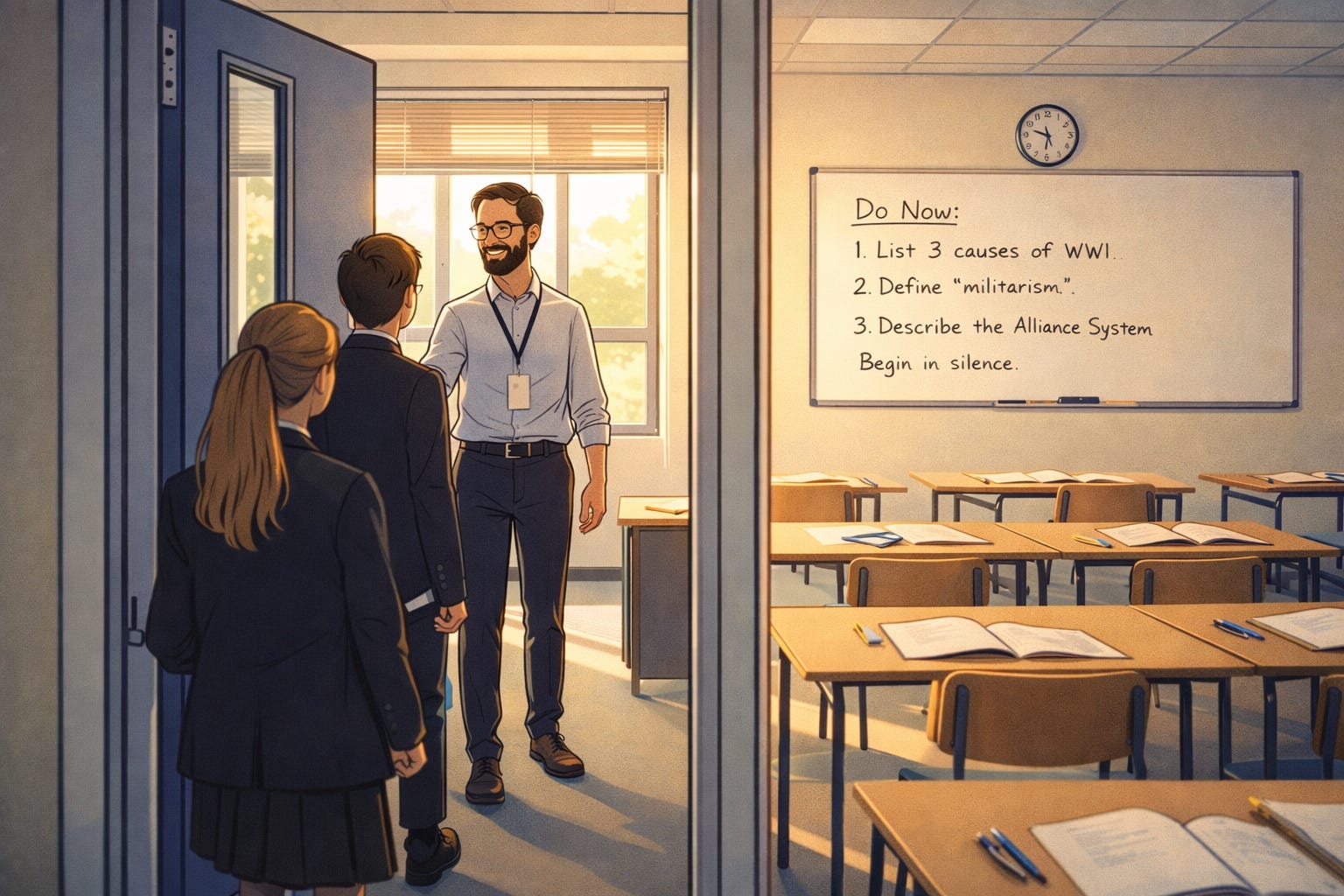
When we looked across the school at raising standards and improving teaching and learning, lesson starts kept resurfacing. Through drop-ins, staff conversations, and the same issues raised repeatedly, the pattern was consistent. Late arrivals disrupted learning. Teachers were resetting rooms before teaching had begun. There was no explicit approach to handling issues and little consistency within teams, let alone across departments. It became clear that the most sensible place to begin was the start.
We had already been working to tighten our lates procedures, but it was obvious the issue was bigger than just a bit of tardiness. It was more about teaching and learning, and culture.
So we chose to focus on lesson starts, armed with Doug Lemov’s Technique 46: Strong Starts and the impact was better than expected. We kept it simple:
Teacher at the door, early. Greeting students and controlling the threshold, so checking uniform and equipment as part of entry, not as a mid-lesson interruption.
Students to know exactly what to do on arrival. Seating plans followed. Silence where required. Instructions short and consistent.
Work waiting. A tight Do Now linked to prior learning (usual retrieval practise), doable without support, with answers ready for self-checking within five or six minutes.
Teachers circulating immediately and checking learning during those first few minutes.
We backed this with CPD, shared examples, and made the standard and steps explicit in the playbook I was curating, so very little was left to interpretation.
The improvement was quick with lessons starting sooner and corridors felt calmer. Teachers were spending less time resetting and reported more time teaching.
Feedback from teachers and leaders was consistently positive. What stood out was that the impact went beyond lesson starts. Many staff commented that once the opening of the lesson was tight and predictable, they began thinking more carefully about what came next. This meant that explanations improved, transitions tightened and the rest of the lesson generally benefited. After a tight, deliberate start, it made sense to keep that standard up for the rest of the lesson.
I see this as a genuinely successful piece of work and one I am proud of. More importantly, it shaped much of what followed. It reinforced for me what effective implementation actually looks like in practice, not as theory.
We started with a real problem and resisted the urge to jump to solutions. The issue had already surfaced clearly through drop-ins, staff conversations and emerging patterns across the previous academic year. Behaviour at lesson starts was inconsistent. Expectations were unclear. Practice varied within teams and even more so across departments.
Timing mattered. Beginning at the start of the academic year gave us the necessary space to work deliberately. Leaders first. Then the full staff body through INSET. Expectations were explicit, shared and reinforced. There was also a simple logic to the focus. If we want to improve teaching, the most obvious place to begin is where learning begins.
By committing to one priority and pursuing it relentlessly across all departments, we avoided dilution. The message was communicated clearly before implementation, reinforced during rollout and sustained afterwards. That consistency created a genuine sense of collective effort rather than another initiative to endure. Even now, long after the initial rollout, lesson drop-ins by SLT and middle leaders remain tightly focused on this specific phase of the lesson. The practice has stuck, which is the real test.
It also helped re-centre the conversation on teaching and learning through behaviour. We have excellent students, which can create the false assumption that behaviour does not require active management. Even highly capable students benefit from precise instruction, explicit expectations and dependable routines that remove uncertainty from learning.
Strong starts are now planned, practised and protected. With that embedded, we moved on to Focused Finishes as the logical next step, tightening learning further and clearly bookending lessons.
“By committing to one priority and pursuing it relentlessly across all departments, we avoided dilution.”
This. 100 times this. Thank you.
The shift toward paper, whiteboards, and proximity made student thinking visible in a way dashboards often promise but rarely deliver in the moment. That immediacy matters. When misconceptions surface quickly, teaching can actually respond instead of review later (or not at all). The increased effort students noticed — that learning felt “harder” — feels like confirmation, not a problem. Productive difficulty is often exactly where durable learning forms.