

There’s been a lot of chat about belonging lately, with plenty of it centring around relationships in schools. Relationships sit at the heart of conversations about learning, behaviour, engagement and culture. In many places, including ours, there is a strong emphasis on 121s with students as a way to offer support and build trust.
When something is not working, the diagnosis is often relational. Are the relationships weak? Is connection missing? Do students feel known? And the solution offered is usually the same. Build rapport. Invest time. Show you care. I’ve even heard it said that you need to build relationships and get buy-in from students SO that you can teach them.

It sounds right, and humane. But it is also the wrong way round. Excellent teaching is not, and should never be the reward of good relationships. Great teaching is the cause of them. I wrote recently about warm demanders - high care paired with high expectations, with care underneath insistence. The idea and research around it supports this. Warm demanding is not about being nice first and rigorous later. It is about rigour with care.
When I think back to my own school days, everyone’s favourite teachers were never the ones who prioritised being popular or having a laugh with the students. Those teachers might be great in the moment, but they were not respected. The teachers who were respected, and the most trusted and valued were often also described as the ‘strictest’. You knew where you stood; boundaries were clear. Their room felt safe, something pretty rare at the all boys school I went to in the early 90s. Those teachers were warm demanders, not that they would have ever used that language back then.
Doug Lemov is practical on this in Teach Like a Champion 3.0. He sets out five guiding principles, mental models, for how learning works to help teachers apply the techniques in his book. The fifth is what I’m talking about here. “Teaching well is relationship building”. Relationships are built through what happens in the classroom, not as a prerequisite to it.
Lemov challenges that familiar, well intentioned line: Students will not care what you say until they know that you care. He never argues against care but does challenge the sequence in which care is shown, and the priorities in the classroom in how relationships are built.
His position: Students trust you because learning reliably happens for them in your room.
This aligns with what we know about the science of learning. Learning requires attention, clarity, retrieval, feedback and a sense of safety. None of those are produced by performative warmth or by actively trying to build the relationship in a classroom. They are produced by structure, clarity and competence. When students experience success through their own effort, trust follows. When effort leads nowhere, no amount of friendliness or warmth compensates.
Teach Like a Champion is practical and clear. Relationships are built by applying the techniques within the book, which make you a better teacher. Lemov notes that earlier editions were criticised for lacking a chapter on relationships, as if that absence implied he did not think they mattered. He responds by suggesting the whole book is about relationships. I agree. None of the techniques are labelled explicitly as being for relationship building, but many create the conditions in which trust forms quickly to allow relationships to form, grow and strengthen.
Here are a few TLAC techniques and how I see them do the job of building relationships:
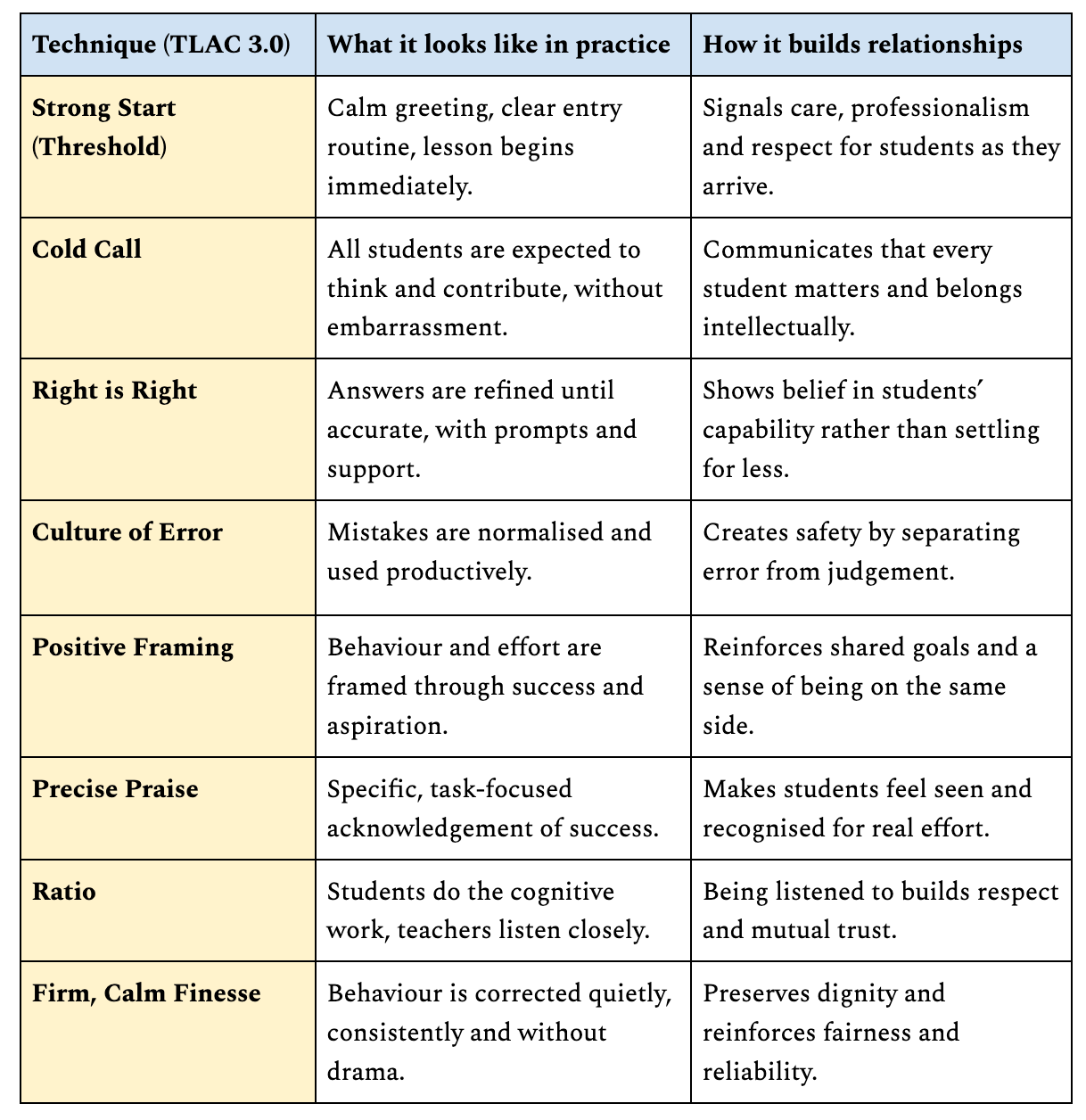
When classrooms are orderly, predictable and academically purposeful, students feel safe. Not just socially safe, but intellectually safe. They can attempt answers. They can be wrong. They can improve. That safety is the foundation of trust, and it is where relationships begin and develop.
Success is critical too. When students experience progress, when they can see themselves getting better, they infer something important: this teacher can help me learn. My effort is worth something here. This builds credibility and trust.
Barak Rosenshine’s Principles of Instruction suggest that during guided practice, students should be successful around 80% of the time before a teacher moves on. The logic here is intended as instructional rather than motivational. If success is much lower, the material is likely too complex or insufficiently modelled, increasing the risk that errors become embedded. If success is much higher, the work may not be demanding enough to extend understanding. Around 80% therefore signals an appropriate level of challenge… demanding enough to require thinking, but successful enough to consolidate learning and build confidence before independent practice.
When students experience this level of structured success over time, they are more willing to participate, attempt answers and take academic risks. This contributes to a classroom climate in which challenge feels predictable rather than threatening. Gradually, instructional credibility develops. Students are more likely to accept difficulty when prior experience suggests that modelling, scaffolding and checking for understanding will be in place. In this sense, strong classroom relationships are supported by high expectations paired with reliable instructional support.
This is not an argument for indifference, distance or emotional flatness. Students arrive with histories, pressures and vulnerabilities that do not disappear when the lesson starts. In our setting, 121s play an important role. They create time and space to notice patterns, listen carefully and help students make sense of what is happening in and around their learning.
However, these moments are most effective when they sit alongside instructional credibility rather than in place of it. High care without high-quality teaching risks becoming pastoral containment. It may offer reassurance, but it does not reliably build confidence. When learning consistently happens in the classroom, 121s tend to deepen trust rather than compensate for its absence. They circle back to learning rather than substituting for it.
This is also why we ensure our pastoral systems are explicit and deliberate. We use CPOMS to record safeguarding and child protection concerns carefully. We are tightening how we log 121s, general information and behaviour concerns so patterns are visible and support is coordinated rather than anecdotal. We talk deliberately about every student having five trusted adults, so responsibility is distributed rather than concentrated in a single relationship. These systems function as enabling conditions. Their effectiveness still depends on the quality of day-to-day instruction.
Alongside this sits an expectation of academic care. Knowing students, noticing patterns, following up and holding the line on learning signal care through instruction rather than around it. A previous strategic focus on belonging moved us forward. The next phase is to ensure that belonging is secured through successful learning itself.
So, the effort towards developing relationships and ensuring students are known is not a separate programme. It emerges from teaching that is clear, structured and responsive. Not primarily through corridor conversations or personal disclosure, but through remembered answers, referenced mistakes and noticed improvement.
Belonging alone does not reliably produce learning. Successful learning experiences often precede and strengthen a sense of belonging. When relationship building is prioritised ahead of secure routines, clear explanation, modelling, practice and feedback, students may feel comfortable but not competent. That comfort is fragile when work becomes demanding. Anxiety increases when there is no experience of success to anchor confidence.
Teaching well, therefore, has to be the starting point. The most relational act a teacher can perform is to run a classroom where learning happens deliberately, every day. Everything else follows.
Excellent point well made.
Too often, teaching quality is positioned as something that comes after rapport is secured, rather than the mechanism through which trust is earned. Your argument makes clear that students don’t buy into learning because they feel liked; they buy in because learning reliably happens.
The connection you make to Lemov and Rosenshine lands strongly here. Predictability, clarity, and a high success rate aren’t just instructional levers; they are trust-builders. When students experience challenge that feels purposeful and survivable, they develop confidence not only in the teacher but in themselves. That’s a powerful form of belonging — one rooted in competence rather than comfort.