

In a previous post - Professional Inheritance - I described the learning I received during my PGCE in 2005: a training climate in which direct instruction was treated as pedagogical backwardness and the ‘all bells & whistles’, student-led, high-engagement classroom was presented as the gold standard. That piece was about how ideas embed themselves before you have the means to question them. This one began after listening to the audio version of Hattie’s Visible Learning: The Sequel on a long-haul flight, and is about the evidence that underpins what we now know about how young people learn best.
Hattie draws on Clark, Kirschner and Sweller’s description of the ‘pedagogy delusion’ from How Teaching Happens. They define it as a “set of beliefs and assumptions about what should happen in a classroom that is characterised by a rejection of evidence.” It is, in their words, “an acceptance of the romantic and philosophical”…“a celebration of the superficial in the form of fads and myths”…and “an assertion that pedagogy is an end in itself.” In practice, this reduces teaching to generic methods, detached from both content and the evidence on how learning actually occurs.
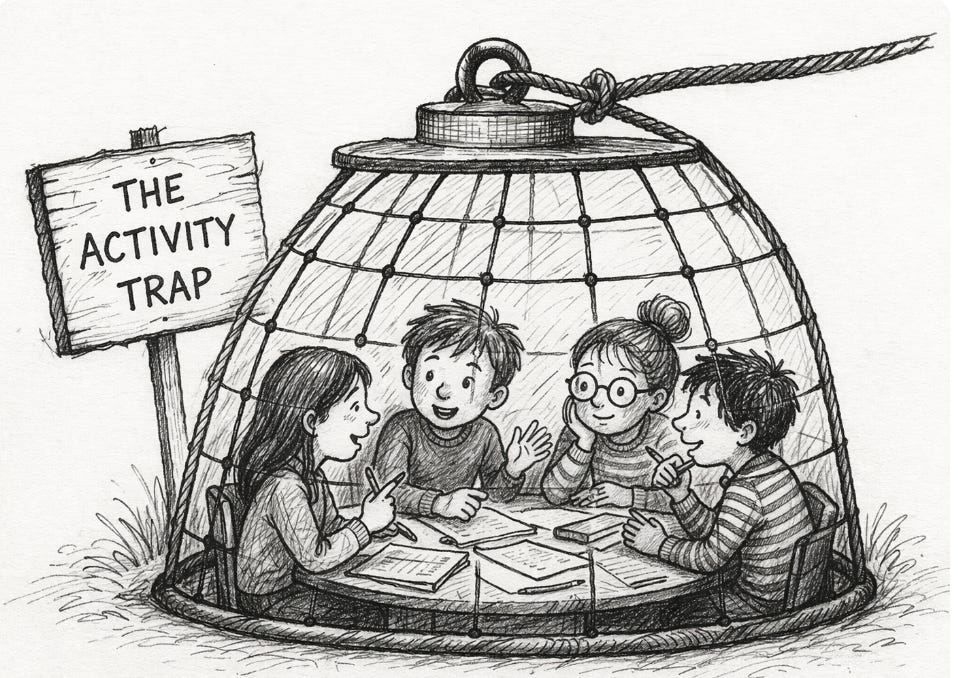
Discovery learning has a seductive internal logic. Children learn by doing, so give them a problem and let them find their way through it. Step back, facilitate, be the guide on the side. The teacher’s job is to create the conditions for understanding, not to transmit knowledge directly. In 2005, this was simply teaching. There was a self-evident truth and was pretty much all we were shown on my course.
The intellectual genealogy runs deep. Rousseau argued that children should learn through experience, not instruction and John Dewey built an educational philosophy on it. Jerome Bruner formalised it in the 1960s under the label “discovery learning,” and by the time it reached teacher training programmes in Britain, it had moved from a theory to an orthodoxy. Interestly, in researching for this article, I learned that Dewey himself had rejected hands-off child-centred learning, and what teacher training inherited was a flattened version of his ideas, shorn of that qualification. Robert Peal’s observation in Progressively Worse - that progressive ideology became so embedded it ceased to be recognised as ideology at all - describes precisely the environment I trained and taught in for the first few years of my career. David Didau, reviewing the book in 2014, noted that his own training had presented the same orthodoxies as unquestionable, like mine - that he had never even heard the term ‘progressive’ applied to education.
What was less commonly known to us in the profession at the time was that the research disagreement had been running for decades. By 1969, review articles were already reporting that experimental results on discovery learning were “conflicting and often insignificant.” The data had been accumulating for thirty years before I set foot in a classroom. Nobody had told me, or most teachers I knew.
The clearest statement of the problem came in 2006, when Paul Kirschner, John Sweller and Richard Clark published Why Minimal Guidance During Instruction Does Not Work. Their argument was structural, not ideological. Discovery learning ignores the architecture of human cognition. Working memory is severely limited. A novice learner, confronted with an open-ended problem and no explicit instruction, is not engaged in productive inquiry - they are managing cognitive overload. The absence of guidance does not free students to think. It floods the very system through which thinking happens.
The mechanism is critical. Cognitive load theory distinguishes between the mental effort required to understand new material and the mental effort spent managing the learning task itself. When novices are asked to discover concepts they have not yet encountered, most of their cognitive resource goes to navigating the task rather than processing the content. The appearance of engagement - the visible activity, the discussion, the movement around the room - can be entirely genuine while the learning remains shallow and fragile.
John Hattie’s synthesis of meta-analyses, now spanning over 400 million students, gives this statistical weight. Direct and explicit instruction sits at an effect size of around 0.59. Problem-based learning lands at 0.26. Inquiry-based teaching, depending on how it is implemented, comes in between 0.31 and 0.46, which is often below the 0.40 threshold Hattie uses as the hinge point for meaningful impact. These are not marginal differences. They represent consistent, large-scale patterns across decades of research.
Hattie is careful on one point that often gets lost in summary: discovery and inquiry are not always ineffective. The issue is sequencing. Once students have explicit surface-level knowledge - the “grammar” of the subject, the facts, the vocabulary, the foundational concepts - more open-ended tasks can build the deeper understanding that sits on top of that foundation. The problem is not inquiry learning in principle. It is sequencing: inquiry deployed first, before the knowledge exists to make it productive. That is what the evidence consistently shows, and that is also what my training consistently modelled - in the wrong order. Actually, scratch that. There was no knowledge taught at all. Just enquiry.
Why had the evidence had so little traction and been almost ignored in my PGCE? The honest answer is probably that visible engagement is a powerful signal, and it points in the wrong direction. A classroom where students are moving, talking, building, choosing is a classroom that looks healthy. A classroom where the teacher is explaining and students are listening can look, by comparison, passive. The judgment is immediate and intuitive, but also wrong. In Seven Myths about Education, Daisy Christodoulou writes about how England’s Ofsted, around the mid-2000s, praised engagement and activity while giving low grades to lessons where a teacher taught explicitly. Fluency during a lesson - students participating smoothly, discussions running easily - can create what cognitive scientists call the illusion of knowing: a feeling of understanding that evaporates when the test arrives.
There is also an ideological dimension that has made the evidence harder to hear. Discovery learning is not a neutral pedagogical preference. It carries a philosophical weight. To value student agency, self-direction and experiential learning is to position yourself on the side of autonomy and child-centred dignity. To prefer direct instruction is to risk sounding like you trust teachers more than students, or that you value compliance over curiosity. Those are not accurate characterisations of what the research actually supports, but they had shaped how the debate was perceived inside staffrooms and teacher training programmes for a long time…even now, there are many in education posting online about discovery learning, student choice and that knowledge is no longer important.
The practical upshot for school leaders is pretty clear. If professional development, lesson observation frameworks or coaching conversations default to rewarding visible engagement, they are likely pointing in the wrong direction. The question to ask is not whether students appear active but whether new knowledge is being acquired and retained. Those are not the same question, and schools that treat them as equivalent will keep getting the same results. None of this means lessons should be joyless or that teacher-led explanation requires passive students. Hattie’s own data identifies classroom discussion at an effect size of 0.82 - well above the hinge point - and collective teacher efficacy at 1.57. The strongest classrooms are not those where teachers lecture and students sit silently, nor those where students are released into open inquiry without the knowledge to make use of it. They are places where teachers know precisely what students need to understand, build that knowledge explicitly, and then extend it through targeted discussion, deliberate retrieval and structured elaboration - once the knowledge exists to make those techniques worth using.
The bigger challenge is institutional. A school that has built its teaching philosophy, observation culture, CPD and planning expectations around the busy, student-led classroom will not shift simply by presenting John Hattie’s effect sizes. That assumes the problem is a lack of information, which I doubt very much it ever is.
Underneath sits a set of beliefs about what learning looks like…reinforced over years through observations, praise, positive student voice, active promotion and professional identity. If engagement has been consistently rewarded and treated as learning, then any challenge to that idea doesn’t land as neutral evidence, but as a threat to competence. That is where the backfire effect takes hold. People will protect the model that has served them.
The institution strengthens this. If observation rubrics privilege visible activity…if CPD showcases collaborative, student-led tasks…or if planning templates demand pace and variety…then the system continues to validate those assumptions. In that context, new evidence has little leverage as it runs into a way stronger, lived curriculum of experience.
I guess that is why arguments are still playing out so intensely on LinkedIn and Substack. This is not a debate about methods. It is a defence of frameworks and ideas that have shaped careers. Most of these ideas were absorbed early, before there was enough knowledge to interrogate them, which is what makes them feel so obvious.
The first job is not persuasion through data but to surface assumptions. Making them visible and then creating the conditions for people to examine the gap between what looks like learning and what leads to durable, long term change in memory. Without that, any attempt at change will be absorbed, distorted or resisted by the existing system.
Thank you for this. I have been very interested in this apparent conflation of engagement and learning for some time now, having written about a few different discovery learning school models over the last few weeks. I'd be curious to hear your thoughts on the school arguably at the extreme of the explicit instruction rubric, Michaela Community School, which I am hoping to visit soon. Many thanks again, and would be grateful to hear your perspective