

I recently listened to a podcast with Katharine Birbalsingh, founding headteacher of Michaela Community School, shared by a colleague. She is often described in the media as the strictest headteacher in Britain. Listening closely, that is not what I heard. What I heard was clarity, care and consistent follow-through. Much of it resonated strongly with the work we have been doing over the last few years.
It is worth defining what we usually mean by strict. It is generally taken to mean harsh, inflexible, punitive and joyless. Rules for their own sake. Compliance over understanding. Authority that is enforced through fear, volume or positional power. That is not what I recognise in strong teaching and learning cultures, and it is not what I recognised in the conversation in this podcast.
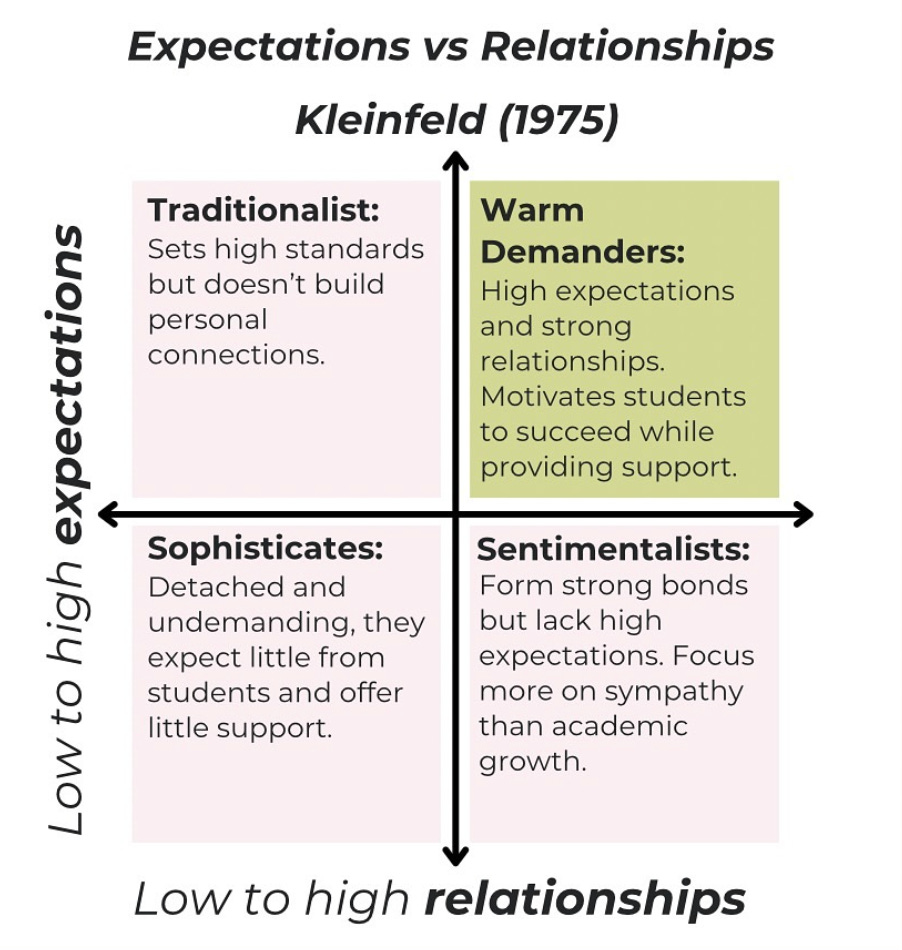
What I see instead is what we call the warm demander.
The term itself comes from the work of educational psychologist Judith Kleinfeld in the 1970s, studying teachers who were most effective with Indigenous students in Alaska. Her insight was pretty simple yet powerful. The teachers who made the biggest difference were neither permissive nor authoritarian. They were warm and demanding at the same time. High expectations, held within strong relationships.
That idea surfaced in our school when we explored and implemented Social Emotional Learning a few years ago. I came across it again more recently whilst researching behaviour. The conclusion is consistent. Students do best when adults care enough to insist.
A warm demander holds high standards and does not apologise for them. They care deeply about students and therefore insist on behaviours that make learning possible. They are calm, predictable, and consistent. They explain the why, but they do not negotiate the whether. Warmth without demand drifts. Demand without warmth fractures trust. The balance is deliberate.
As well as theory, it has to live in routines, systems and in the agency we give teachers to apply them.
Take punctuality. It is not an admin issue. It is a learning habit. When students arrive late, learning is disrupted. So we have become explicit now:
Two lates trigger a catch-up
Three or more lates lead to an after-school detention
An ‘If this, then that…’ approach, like speed cameras - you speed, you get a ticket. You’re late twice (or more), there is a consequence.
We have applied the same approach to wearing ID tags, a safeguarding issue we needed to fix. We are clear that they matter because they signal belonging, safety and respect. Forgetting or losing one has a consequence:
First forgotten ID tag is a 10-minute, same-day detention
Each subsequent incident escalates by 10 minutes
The fourth in a term results in parents being brought in
Clear systems matter. But who holds them matters more.
For a period, we had leaned heavily on faceless processes and automated emails. They were the first step in moving the needle on undesirable behaviours and they did work. Efficient, yes. Human, less so. So, we have deliberately moved more of this work back into the hands of tutors and teachers. The system provides the structure. The adults provide the relationship.
A simple question like, “What happened to make you late?” can open a dialogue. It gives the student space to explain and the adult a chance to listen. The interaction builds trust and is far more likely to lead to behaviour change, or the necessary understanding. The expectation remains firm, but it is delivered by someone who knows the student and has the ability to respond with both judgement and care.
This is teacher agency in practice. Teachers are not bypassed by systems. They are supported by them. The system removes ambiguity and protects consistency, allowing teachers to focus on care, coaching and follow-through and follow-up.
Routines need to be taught, rehearsed and protected. Attendance and punctuality are core conditions for teaching and learning. Corrections need to be calm and consistent. Certainty matters more than severity. Follow-through does need to be relentless (but always human) if it is to work. And it does appear to be working for us.
Care, in this model, is not indulgence. Care is insisting on the standard because you believe the student can meet it. Care is holding the line, every time, so no one is guessing where it sits. There will always be exceptions, and this is where teacher judgement, agency, professionalism and care are paramount. Expectations remain high, and students are supported to meet them. And, in my experience, they do want to.
Behaviour, teaching and learning, and care are not separate domains. Behaviour systems exist to protect learning. Attendance is a curriculum issue because knowledge builds over time and absence creates gaps that compound. Punctuality is culture made visible. Consistency is a form of kindness. Poor habits need to be broken, and we have to care enough to help students become better for themselves and for their futures.
So I don’t think enforcing rules is necessarily strict, it is just being a warm demander.
Thank you for this, Mark.
This article is a powerful articulation of a warm demander in practice at your school.
From a leadership perspective, two questions feel especially pivotal:
How do we sustain warmth as a non-negotiable when staff capacity, confidence, and emotional load inevitably vary across a school?
And how do we design systems that create certainty and consistency without quietly displacing professional judgement, so clarity doesn’t drift back into compliance?
Both feel foundational. If warmth erodes under pressure, or systems begin to do the relational work for us, the model risks becoming something it never intended to be.