

Many commentators, including Sam Harris and Rob Reid have long been vocal about the dangers and threats of AI. Possibly, most concerning and immediate for us in education is what will happen to study pathways and jobs. There is already scary news coming from Microsoft who’ve recently released a research paper on the 40 jobs most and least likely to disappear due to AI.
AI is now mainstream and accessible by anyone. Its utility is wide and limited only by the user’s creativity. There are few jobs out there that have not benefited from AI in some capacity. For many, AI simply saves huge amounts of time and does much of the graft and admin a PA might do. Our office staff are used less than before for those admin-related tasks that were solely their domain. Recently, a principal shared how they’re reshaping the support team at his school with it being close to a certainty that some of the existing support staff will become surplus to requirement due to what AI is doing already.
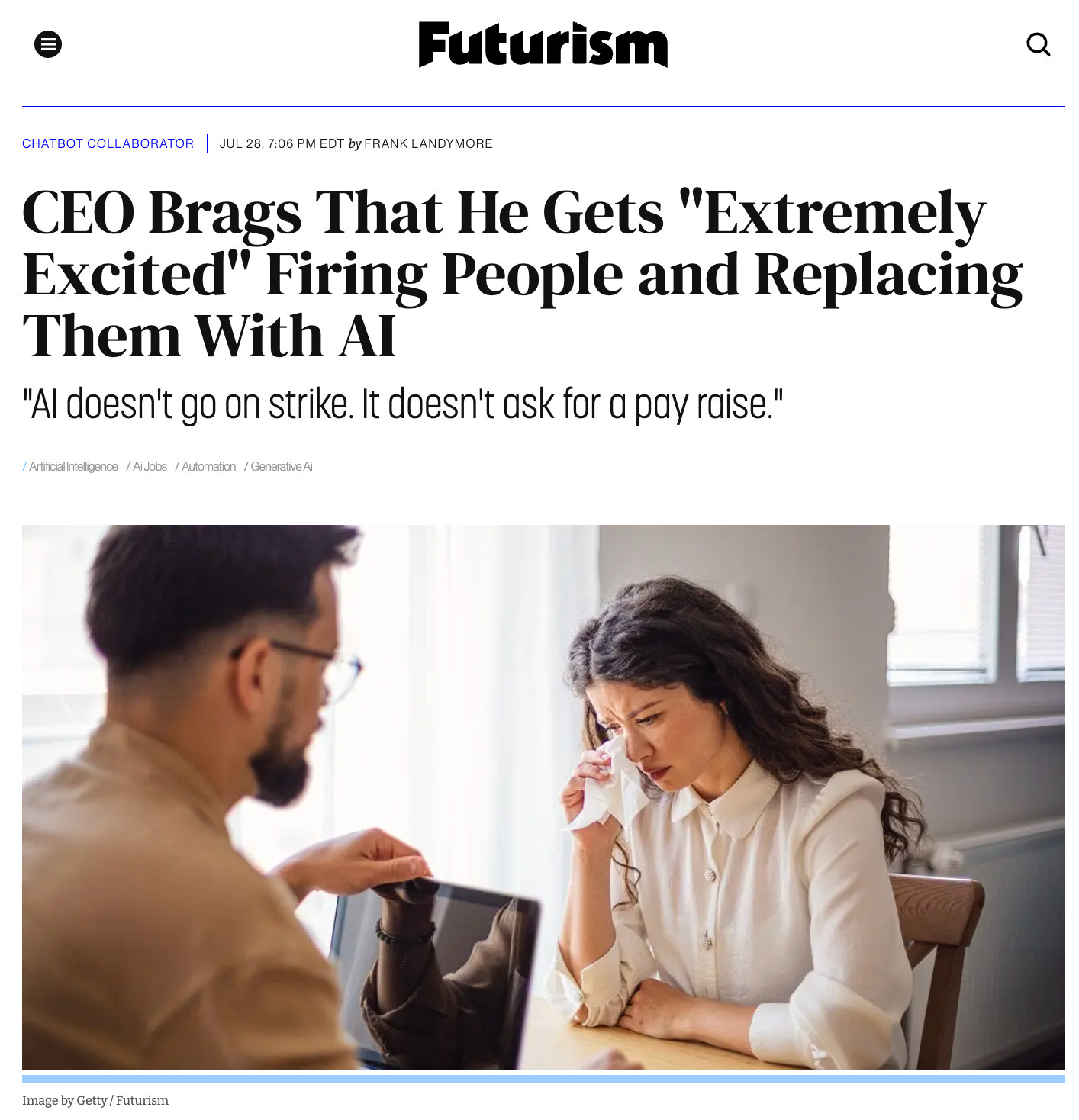
World-wide, job losses are substantial, with this report stating 1000s of US jobs being lost every month, and Elijah Clark, a (heartless?) CEO has bragged about the cost savings of removing people from businesses… (he basically gets hired by other CEOs to help them use AI better to reduce their costs through headcount!). The same article doesn’t confirm whether mass replacement is likely- well, anytime soon, that is.
The trouble for humans is that as much as AI is helping us as individuals now, it is quickly getting good at doing things we thought could only be done by humans. Scarily, the Microsoft research suggests that jobs with higher educational requirements were more likely to be affected by AI. Looking at the list, some are obvious: writers, authors, proof readers, copy makers and web developers. However, there are a few surprises, such as models! I guess AI robots and on-screen AI’s can model better for cheaper and longer without fatiguing, whilst looking exactly as desired. I was hoping economics teachers wouldn’t feature, but they do 😢, along with historians, geographers and mathematicians. Those least likely to be affected are all very physical jobs, and I guess until the cost falls to develop and produce machines that can change tyres, fix roofs, give massages and do house-work without human involvement, those jobs will remain. Those massage chairs in airports are ok, but they aren’t yet good enough to replace a skilled person.
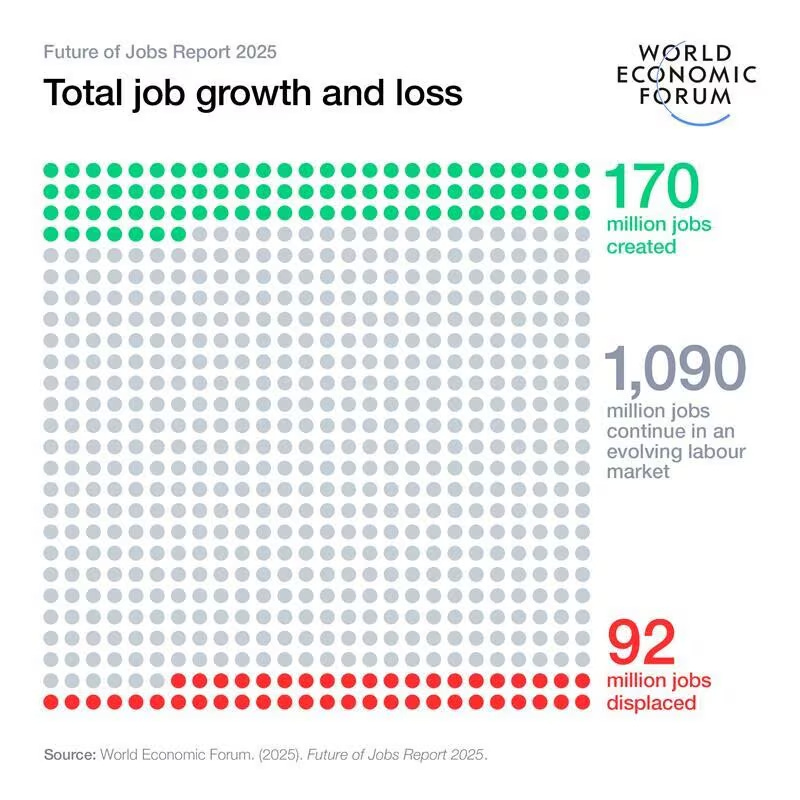
The WEF predicts a net gain of 78 million jobs, but warns that 40% of employers expect to cut white-collar, entry-level roles where AI can automate tasks. Combine that with globalisation - companies expanding into lower-cost talent markets like India - and you have the future that PEW Research foresaw: fiercer competition and fewer entry points for graduates.
This is happening fast with significantly fewer jobs opening up than usual. Recent graduates are finding it harder than ever to find work- 65% of US graduates, a 25% increase year on year, have been unable to secure work. It was only recently, we were telling students that a job in tech was a safe bet, but tech seems to be amongst the hardest hit. There have been huge layoffs for coders with a quarter of programming jobs vanishing in the last two years. This week I have had requests from parents of students starting their IGCSEs to switch from Computer Science to other subjects, citing recent technological developments. It is so hard to know what to do as a student, right now…I am kind of glad my kids are too young that much of this will play out before they need to make big choices. We will hopefully have a better idea in a few years (or sooner, things are moving fast) about what to study…I am not sure if kids the same age as mine (12 and 9) will even ‘need’ to go to university given the current trajectory, which is sad (albeit better for the wallet!)
The Future of work - Is it all bad?
No one can predict the future, but you can follow trends and listen to the range of views. While much of the discourse is negative, not all of it is. This Forbes article suggests a post-work world where AI renders human work unnecessary and Universal Basic Income (UBI) ensures everyone is able to meet their basic needs of food and shelter, thus eliminating many of society’s issues such as crime, homelessness and access to services. UBI is a set financial payment to everyone in an economy regardless of their wealth, employment status or income. It has gained more support in recent years, but critics cite UBI as a disincentive to work. Given the speed that AI is moving, that may not be a problem by then.
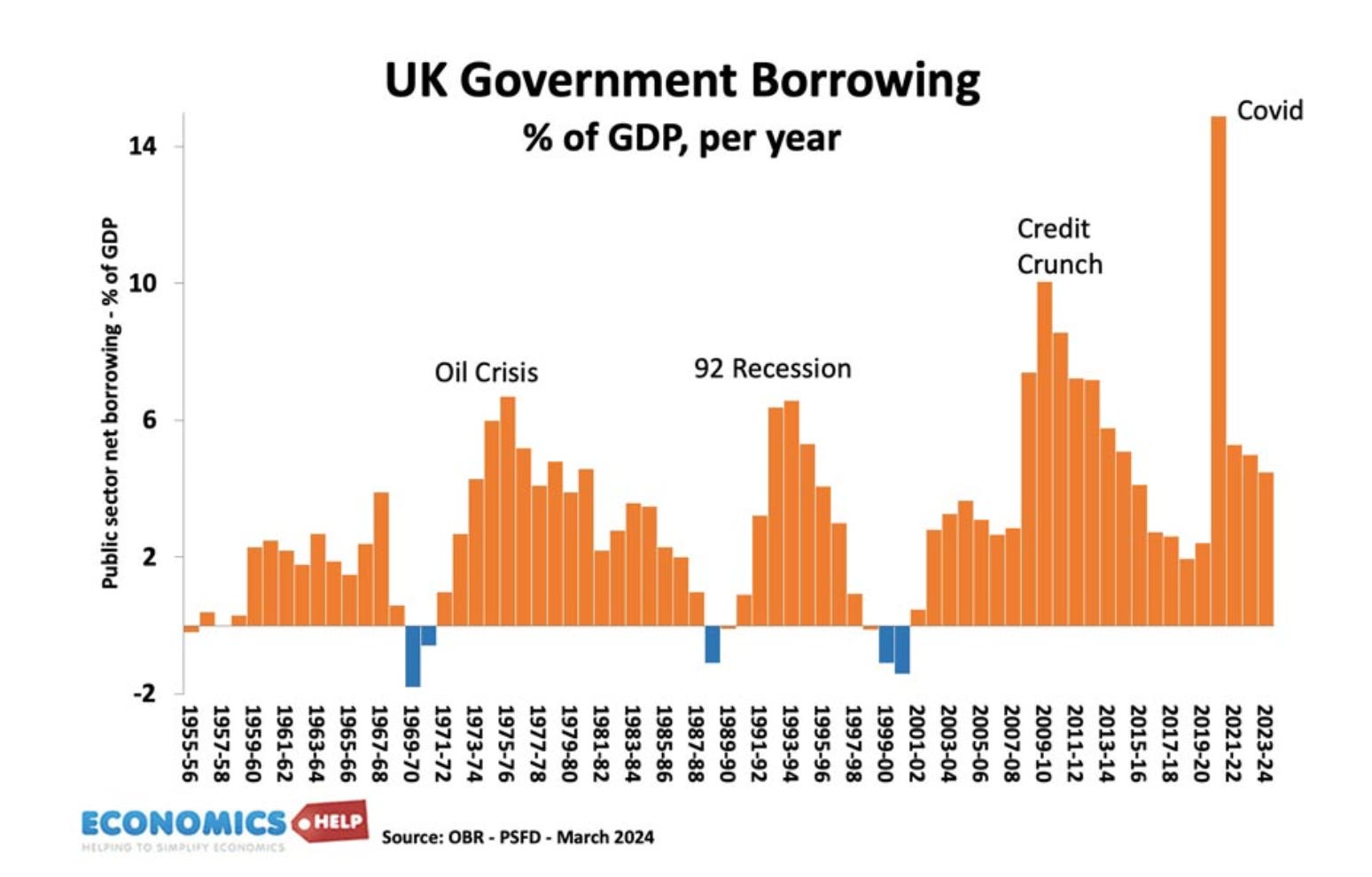
There have been plenty of UBI experiments, but rolling it out on a mass scale will be no small job. Covid attempted this with mostly positive outcomes for income inequality, aside from high costs (see chart below) that added to the amount they won’t be paying back. There will be major political, social and economic considerations and impacts. Should UBI be implemented, some see us living in a form of utopia whereby we exist as a leisure class without the burden of work, unless you want it. Problems then become where will humans find meaning, how will we contribute to society and how much control is given over to the government when everyone is reliant on them for income? It might be amazing: kids might go to school for the sole purpose of learning, not to be shaped for work.
AI is certain to bring many benefits: curing diseases and cancer, offering better ways to solve global problems of climate change and finding effective economic solutions to issues like unemployment and wealth inequality (UBI?), and no doubt many other benefits that I can’t think of now. But are we ready?
100x the impact of the Industrial Revolution
Humanity has been through a number of upheavals due to technological disruption, but some believe AI will be the most disruptive we have ever seen. Demis Hassabis, CEO and founder of Google’s DeepMind and a leader in AI and AGI development recently said that the AI revolution will have 100x the impact of the Industrial Revolution. By this he means 10 times bigger in terms of changes and 10 times faster, and remember the Industrial Revolution lasted 100 years. Haassbis shares a more positive outlook, with what he calls radical abundance being a (hoped for) possibility. Much of his work is about using AI to advance science and medicine and to better understand the world around us. He sees issues like climate change, the water shortage and other major problems being solved through AI. He is surprised that economists and governments aren’t paying enough attention to what will inevitably happen. He urges philosophers, social scientists and those in power to start thinking now, collaborating and working together to shift society’s mindset from it being a zero-sum game. He says we will need a new form of economics in the post-AGI world, which is itself a race with significant first mover advantage. This is especially true as the population continues to grow and jobs disappear through the ongoing, inevitable technological disruption.

Listening to Hassabis, I am not sure we are ready for what is coming. Especially when you hear what the US government’s DOGE was set up to deal with, although moving beyond fax machines was a small win! Whether you think AI as good or bad, you can’t help thinking that we aren’t anywhere near prepared for the inevitable disruption to come…I know most schools aren’t prepared. Teachers everywhere, according to 404 Media, say AI has upended the classroom. Hybrid essays - part student, part robot - are now routine. Students trust ChatGPT over books, can’t always tell fact from fiction, and many struggle with basic vocabulary, with Covid gaps making it worse. Teachers are rewriting assessments, forcing in-class writing, and combing through Google Doc histories to catch cheats. Rules are inconsistent, tech firms bake AI into school systems, and the ethics remain unclear. The result: more policing, less teaching, and a growing sense the job is losing its meaning. Behind it all is a bigger cultural shift towards passive consumption over active thought. If that wins, education as we know it doesn’t stand a chance.
With my students in mind, Hassabis argues that the most effective AI users might be ten times more productive than those who don’t use it. So students do need to immerse themselves in these systems. He still advises studying STEM and that everyone should try to become exceptional at prompting and fine-tuning the models, given that those who use the tools effectively will gain a serious advantage over those who don’t.
The case against mass unemployment
Marc Andreessen argues that fears of AI-driven mass unemployment are overblown - not because AI can’t replace jobs, but because regulation, licensing and entrenched systems slow or block adoption in much of the economy. That may buy time, but it won’t stop AI from changing how work is done, eroding entry-level roles, and widening the gap between those who can use it well and those who can’t.
Cruiseliners in a Speedboat World
Schools feel the need to stay on top of developments, adapt quickly, and keep a finger on the pulse as new tools emerge - but that’s easier said than done. I’ve always seen schools as cruiseliners: huge, slow to turn, needing miles of ocean to change course. By the time the helm has shifted, the world - and the technology - has already moved on. The pace of AI is measured in days, weeks and months; the pace of education is often measured in years. Our job is to prepare young people for that mismatch - to help them thrive in a world where the ground is constantly shifting beneath their feet. As AI flattens many once-academic advantages, traits like character, resilience, adaptability, literacy and ‘learning how to learn’ will matter more than ever. As schools, we should be teaching these - and how to use AI wisely, critically, and creatively.
If AI really does create a world without work but with the means to live well, maybe it will feel like being a teacher on a never-ending summer holiday - something most people, including me, could probably live with.
Its a conflicting scenario as the benefits AI potentially has on healthcare delivery in places like Africa is potentially life changing. However the lack of basic infrastructure would impact these potential benefits. TB, the single largest killer in Africa, where the shortage of radiologists for example impacts its diagnosis is easily solved through AI reading of X-rays (Musk again). However you still need an X-ray machine, radiographer, lab and laboratory technician to at least gather the images and put a sample in a petri dish.
The problem I think is the divide between the haves and have nots, the global south and north will just get bigger as technology and infrastructure is needed in most cases to use the positive components of AI. (You need classrooms to learn in effectively and teachers to teach!)